Category Archives: Church

Thomas Poole, 1884-1891

Chapel Next the Green (the history of Twickenham Congregational Church) index page

The Church wasted no time in finding a new minister for within a month Rev Thomas Poole of Lymington was asked to preach ‘with a view’. Mr E.W.Gates, organising secretary of the LCU came down to chair a Special Church Meeting but on finding that the necessary notice required by the Trust Deed had not been given he advised that the meeting was not competent to call a minister. However there was a general feeling in favour of Mr Poole and two weeks later Mr Gates presided at a valid meeting and a unanimous call was sent. In September 1884 Mr Poole began his pastorate. He had been a minister for nearly forty years but this was only his third pastorate.

The need for an organ, first expressed many years before, was now felt to be a priority and fundraising efforts were renewed.

THE ORGAN IS BUILT

At the December 1885 Church Meeting it was reported that on Tuesday 8th inst. a Recital and Sacred Concert was given in the church on the opening of the organ under the direction of Mr E.Minshall, organist of Dr Parker’s, the City Temple. … The organ was built by Messrs P.Conacher of Hudderfield for £250 and after thorough examination and trial by the organist of St Mary’s Church, Twickenham, it was pronounced by him “a very desirable instrument perfectly satisfactory in every respect and admirably adapted to the requirements of this Church.”

Mr William Gould was presented with “a Purse containing eighteen sovereigns as a recognition of his services at the harmonium for some years past” and was succeeded by the first organist, Mr Frederick Freshwater.

During this period the church was still being supported by the LCU. It was not until 1891 that the Treasurer was able to report that the ‘church was now self-supporting after 13 years of grant’. Over this period the grants totalled £927 and had kept the Church alive over a very difficult period.
At the end’ of 1886, according to one of the grant applications, 158 sittings were let at an average of 4/6d per quarter. Congregations averaged 160 in the morning and 190 in the evening (including about 50 children at each service). The Sunday School had 104 scholars, average attendance 42 in the morning and 71 in the afternoon. The stipend was £200 and other expenses totalled £53.8.4d . In support of the grant application it was mentioned that several members were leaving the district, one of whom contributed £52 per year. The latter was Augustin Spicer whose previous generous giving has been noted.

Over this period the minutes give the impression of uneventful steady growth in the Church until Mr Poole resigned in April 1891, “stating it was entirely the result of the breakdown in health, especially his loss of voice. The eminent medical authorities he had consulted ordered lengthened rest stating that nothing else would meet the case. He had rested more than six weeks but no improvement had taken place.” On this sad note he ended 46 years in the ministry, leaving behind a church that was spiritually and financially stable. He died in August 1912 aged 89. The CYB recorded that he was “always the most optimistic of men … His genial nature made him popular as a pastor and he left behind him happy memories in all his pastorates”.


← Aurelius Gliddon, 1882-1884 – – – Arthur Calvert, 1892-1895 →

George Hunt Jackson, 1865-1871

Chapel Next the Green (the history of Twickenham Congregational Church) index page

Some little time was to elapse before Mr Jackson accepted the pastorate. Little is known about him but his pastorate was an eventful one. He had ministered at Chatteris, Cambs. from 1858 to 1860, and then went to Ireland where he had three short pastorates within four years before spending a period in Dublin without pastoral charge.

It is possible that he first came to Twickenham on a temporary basis; Abraham Slade recorded on Dec 10th 1865 that: “Mr Jackson has his first sermon last sabbath morning in the Independent Chapel (first of the three months engagement)“.

The uncertainty regarding the claim from the trustees of Lady Shaw estate had been lessened in April 1865 when the chapel was mortgaged to Andrew Bowring, formerly a local resident and member of the committee, who had a hosier and glover’s business in the City. The trustees were entitled to redeem the mortgage on payment of £596.14.4 plus 5% interest.

The members were evidently anxious to secure their chapel, and on 14th June 1866, with the consent of the original trustees, Andrew Bowring conveyed the chapel to eleven trustees representing the church,
… the said purchase money being deemed to be a fair price for the chapel and its land .. but the said Andrew Bowring is minded to include the school and premises hereafter described in aid and furtherance of the good object to which the said chapel, school and premises are to be applied …

Mr Bowring had evidently purchased the school separately and was making a gift of it to the Church. At that time a fence marked the boundary between the buildings. For his generosity and business acumen subsequent congregations have cause to be grateful.

The new trustees were eleven in number: George Hunt Jackson (Minister), William Brown (Builder), Charles and Alfred Deayton (Grocers), Alfred J. Hicks (Gentleman), Thomas Peard (Ironmonger), Eldred Sayers (Draper), Abraham Slade (Builder), William Standen (Gentleman), John P. Teede (Tea Dealer), and Charles Warner (Coachpainter).

According to the new deed the chapel and other buildings were:

to be enjoyed as a place for the public worship of God according to the usages of Protestant Dissenters of the Congregational Denomination, commonly called Independents, being Paedobaptists… (i.e. practising infant baptism) such persons only are to be permitted to officiate who are of the Denomination of Paedobaptists and who will hold, teach, preach and maintain the following Doctrines …”. There follows a list of ten doctrines with a proviso that: “the Church should be conducted on Congregational or Independent principles, namely the members should have full power to manage their Church . . . according to their own interpretation of the Holy Scriptures“.

THE NEW CHAPEL

Now that the Church was again fully independent, no time was wasted with proceeding with the ‘additional accommodation’. In 1866 the Chapel was rebuilt in its present form, incorporating gallery, porch and boiler room, and was linked to the school by the vestry block. Two smaller rooms were added to the enlarged schoolroom.

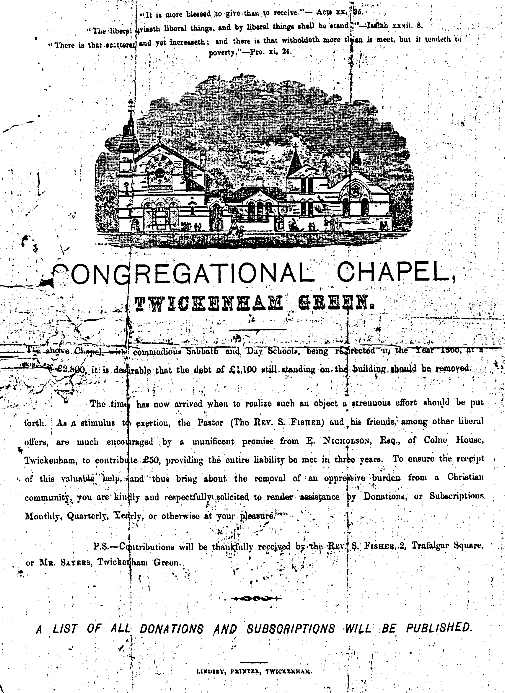
An illustration of the rebuilt premises appeared in the Congregational Yearbook 1867 (above) with the architect’s comments:

“The buildings, which present a specimen of very successful planning and effective grouping, were designed with a view of making available, as far as possible, the old buildings and materials, and are of brick, picked stocks, with red brick and Bath stone dressing partaking of a Byzantine character, adapted to the purposes of the buildings and materials used. The walls of the Chapel are raised and the whole covered with new open timbered tie beam roof ceiled between the rafters . .. The gas lighting by pendants from the beam and the warming by hot water pipes.

J.P.Manning Esq, Mitre-court, Fleet Street, Architect.”

The architect’s drawing (above) is interesting in that at the top left we see the original 1844 chapel. We also see that his intention was for the organ, when installed, to be on the end wall of the chapel.

Not all observers were enthusiastic about the ‘effective grouping‘. in 1873 a reporter from the RTT commented (full report here):

Had Solomon been an architect and seen the Congregational chapel on Twickenham Green (he) would have been sorely puzzled to define its architecture correctly. The gentleman from whose very original brain the design emanated need not fear a charge of plagiarism in matters architectural. In appearance the building is unique, and as a matter of taste it is a question whether it would not be well for it always to remain so, seeing that the elevation, which is Mediaeval, Norman-Gothic etc, is as heavy as it is unartistic… were it possible to speak in terms of praise, consistently with truth of this curious conglomeration of bricks and mortar, it would give me great pleasure to do so, but I have to write what I think, and therefore am bound to confess that beauty is not an element in the design. … Nor is its interior any more pleasing than its outwards appearance”.

Abraham Slade had other reservations about the rebuilding which he recorded in particular detail:
Oct 21st 1866: “The people are altering the Independent Chapel and I am afraid they are going to entail a heavy mortgage on it which will be a heavy drag to my neighbours as well as myself and family. In order that my children may know how this was brought about I will make a brief statement of the facts connected with it.

When Lady Shaw died she died intestate — and 560 pounds been lent by her at the erection of the chapel so that her heirs made a claim for that amount – so that the trustees were obliged to raise the money and in order to do so the whole of the property was sold to Mr A. Bowring of Fenchurch St, London, and the people then formed a committee of 12 to carry out the repurchase of the property from Mr Bowring and among the rest my name was placed.

A scheme was set on foot by a few of the leaders of this movement to borrow six hundred pounds and pay off the debt and raise the money by degrees and then pay off the six hundred pounds and to this I consented. But some few were not satisfied by this but wished for alterations to the property that would involve a very heavy outlay.

To do this they employed a London architect to prepare plans and specifications and get tenders for the works – The lowest being 1560 pounds, which was accepted — which made including the formal purchase about 2160 without any provision for gas or heating and sundry other matters amounting in all to about 2800 pounds …

I feel sorry that my name was associated with a proceeding which, instead of helping on the cause of Christ, I am afraid will be a heavy clog to it. I would advise all my children to beware how they act in these matters, and never in any way lend themselves toanything that will leave a heavy entail upon others.”
The debts on the property were to be a stumbling block for many years. On Jan 27th 1868, Mr Slade recorded: “The trials of our chapel are fast now coming on – £500 wanted and we don’t know how to raise it.
” A further loan was raised from the London Congregational Chapel Building Society and evidently money was owed elsewhere.

It appears that Mr Jackson may have been in poor health for his final two years. One note suggests that Willian Freeman, minister of the Baptist Church 1861-71, exercised some oversight. Certainly he knew the church well; his induction service had been led by Mr Ingram. Looking back on the year past, Abraham Slade recorded, on January 1st 1871: “Our Congregation Chapel does not well fill. Mr Jackson, our minister, has been ill six months and the pulpit has been supplied by neighbouring ministers, which does not tend to forward the cause of Christ here (as we have no pastor)”.

Stowford Cottage, Twickenham Green

That year Mr Jackson ended his eventful pastorate and resigned from the ministry. He continued to live in Twickenham, at Stowford Cottage, which still stands facing Twickenham Green.


← George Ingram, 1854-1864 – – – Samuel Fisher, 1871-1877 →

Morning worship 1873

Chapel Next the Green (the history of Twickenham Congregational Church) index page

An account printed in the Richmond and Twickenham Times, Saturday October 11, 1873. Additional paragraph breaks have been added to improve readability.

CHURCH AND CHAPEL

[Each week a part of our space will be devoted to descriptive notices of the Sunday services at the various churches and chapels in the neighbourhood. In giving these reports a fair and impartial spirit will be maintained; at the same time they will not be restricted to a meagre and dry statement of facts, but an endeavour will be make these sketches not only truthful but interesting. We trust that our readers (and especially those to whom these reports particularly relate) will regard them in the kind spirit in which they are written. Ed. R.T.T.]

TWICKENHAM CONGREGATIONALISTS

A strict Independent Congregation is a complete spiritual republic, all other republics are incomplete. In those they act by their representatives ; but in this . . . . all act for themselves . . . . The minister is the speaker and only the speaker in this spiritual House of Commons. – Rowland Hill.

They [the Independents] conceived that every Christian congregation had, under Christ, supreme jurisdiction in things spiritual ; that appeals to provincial and national synods were scarcely less unscriptural than appeals to the Court of Arches or to the Vatican ; and that popery, prelacy, and presbyterianism were merely three forms of one great apostacy. – Macaulay on the rise of the Independents (circa 1643).

These were the opinions which Macaulay tells us the early Independents held.

These were the tenets contended for by Pym, and Hampden, and Cromwell (the great leader of that religious body, “the soul of the party” in the House of Commons, at a period-

When civil fury first grew high,
And men fell out, they knew not why ;
When hard words, jealousies, and fears,
Set Yolks together by the ears

and these noble men were the staunch and sturdy supporters of the sect whose tenets, handed down from generation to generation (but largely tempered with Christian charity and forbearance), are firmly held by the Twickenham Congregationalists. It is hardly necessary to say that Congregationalism and Independence are identical. Why there should be a strong leaning towards a general adoption of the former name amongst most of the newly-formed churches in this body, I am at a loss to determine, and why the old fashioned name of Independent is going out of date I am unable to explain. It would be interesting to know the why and because of this very evident fact, and I leave the solution of the problem to those of my readers who are learned in the lore of the sects, as it is more my province to write of Twickenham Congregationalists, their chapel, their preacher, and their service last Sunday morning.

Had Solomon been an architect and seen the Congregational chapel on Twickenham Green, I question if even “the wise man” would not have been sorely puzzled to define its architecture correctly. The gentleman from whose very original brain the design emanated need not fear a charge of plagarism in matters architectural. In appearance the building is unique, and, as a matter of taste, it is a question whether it would not be well for it always to remain so, seeing that the elevation, which is Mediaeval-Norman-Gothic-&c., is as heavy as it is inartistic.

On so good a site, with the broad open Green before it to lend effectiveness and beauty to a pleasing elevation, it does seam a matter for regret that the chapel is not as pleasing to the eye as it might have been, had a little more taste been displayed in its design. As it stands, it is a kind of architectural sphinx, for it remotely suggest a Rhenish castle in miniature, a one storied ecclesiastical villa, an attempt at a church, and a churchified chapel. Were it possible to speak in terms of praise, consistently with truth, of this curious conglomeration of bricks and mortar, it would give me pleasure to do so, but, I have to write what I think, and therefore I am bound to confess that beauty is not an element in the design of the Twickenham Congregational Chapel.

Nor is its interior any more pleasing than its outward appearance. Both are wanting in finish and completeness. The pews are not even painted and in consequence, time has left its mark upon them in many grimy patches. Mischievous little hands have exhibited their artistic powers by sundry pencil sketches of the heads of ladies and gentlemen which forcibly display the appreciation of the grotesque in juvenile minds and their ingenuity in extemporising drawing boards in the most unlikely places, even on the back of pews, underneath the shadow of the pulpit.

It will not, however, be long before the chapel is thoroughly renovated (or perhaps it would be more correct to say completed) as one of the announcements made at the morning service was to the effect that a special meeting would be convened during the week to take into consideration the improvements and repairs which were necessary. The chapel has an open roof, and over the entrance is a deep gallery, the seats being well arranged so that all the congregation, both there and in the body of the chapel, can see the preacher.

The place he occupies it is not easy to describe. It is not exactly a platform, nor is it exactly a pulpit, but perhaps it is more the former than the latter. Elevated on a structure of red and white bricks, and partly polished wood and partially painted, after the Mediaeval style of decoration, it presents a most singular appearance, an idea of which it is not possible to convey in words. It excites some wonder in the mind of the visitor, but whether wonder and admiration are combined depends entirely on the taste of the stranger in matter relating to architecture and ecclesiastical decorations.

At the chapel door was a circular containing an appeal in reference to the removal of the debt on the building. It was dated September 5th, 1873, and the names of contributors, and the amounts of their donations were preceded by the following notice:-

This chapel with commodious Sabbath and day schools, being re-erected in the year 1866, at a cost of £2,800, it is desirable that the debt of £1,100, standing on the building, should be removed. The time has now arrived when to realize such an object a strenuous effort should be put forth. The pastor (the Rev. S. Fisher) and his friends have been much encouraged in this movement by the response it has called forth. As a stimulus to exertion, E. Nicholson, Esq., of Colne House, Twickenham, has promised £50, providing the entire liability be met in three years. Since that liberal offer, S. Morley, Esq., M.P., has offered £100, if in two years the amount due be paid ; and that this latter sum, as well as the former may be secured, no appropriate means will be left untried. Hence this appeal, which is recommended by the Revs. J Kennedy, D.D; J. Stoughton, D.D; E. Paxton Hood; R.D. Wilson, Craven chapel; J. Raven, Felstead (late of Ipswich) ; R. Berry, Lambeth; H. Davies, Lavenham ; and Mr A. Fountain, of Ealing. Will you kindly aid us by a donation, or promise conditional upon the completion of the enterprise?

This appeal has been nobly responded to. Since the settlement of the Rev. S. Fisher, at Twickenham, only two years since, in addition to the clearing off of heavy interest and other arrears, something like £985 has been secured by promises and contributions towards the debt of £1,100 on the chapel and the Sabbath and day schools adjoining, and so well do the pastor and his church work together that it is hoped that the entire liability will be cleared off by the end of the year. There is an old proverb to the effect that “God helps those who help themselves,” and certainly a more pleasant illustration of its truth could not be readily found than in the resolute and successful endeavour of the Twickenham Congregationalists to rid themselves of debt. Contributions towards removing the small balance of the debt will be thankfully received by the Rev. S. Fisher, 7, Nelson-terrace, Twickenham Common, or by the deacons of the church.

But at the chapel doors, there was another notice which should have an especial interest for the young men of Twickenham. It was headed, “Twickenham Mutual Improvement Society,” and if I remember rightly, below was an intimation to the effect that its meeting are held weekly in the schoolroom adjoining the chapel. Such institutions merit success. Their indirect value to the congregations with which they are associated cannot be well over estimated ; and properly conducted they form a very useful auxillary to the church. It is then on such grounds that the Twickenham Mutual Improvement Society, commends itself to the young men of the neighbourhood, and more especially to the youthful portion of the congregation with which it is identified. The society, being one of recent formation, it is all the more desirable that its members should receive every encouragement in their good work, and additions to their ranks of young men, who may be quite sure of a hearty reception, pleasant evenings, and rational and intellectual enjoyment.

One of the uppermost thoughts in the minds of most Dissenting deacons in reference to church matters is the kindly welcome of strangers and their comfortable accommodation in the house of God. There is here much of the wisdom of the serpent, combined with that other attribute, enjoined by the Saviour on his followers, the harmlessness of the dove. First impressions, in religious as well as worldly matters, are sometimes everything. To be welcomed with a kindly smile, to be place in a comfortable seat, and provided with a hymn book is pleasant ; but to be left in a draughty aisle, to be jostled and pushed by seat-holders’ who must parade their puny pomposity before the Most High, and at last to be shunted into an uncomfortable seat by a consequential pew-opener is being “stroked the wrong way” to such a fearful extent that a second visit by the “sat upon” stranger to a sanctuary where such treatment of outsiders is tolerated is, to say the least, a doubtful event.

Dissenters are keenly alive to the sensitive feelings of visitors, and are fully aware what an ecclesiastical “Jack-in-office” a pew-opener may become, and how he may, by his injudicious conduct, disgust his betters, and drive the timid from the church they fain would make their home. Who is there among us who has not experienced a pew-opener’s withering scowl, his unspoken “stand back there, ” and his unmistakable snub ; who has not waxed wrath at such treatment, and felt that the pleasures of the service have been completely marred by such ugly reception? Aware of these little peculiarities of no insignificant portion of the pew-opening community, there are many chapels which the deacons perform the duties of this office, at the loss of no dignity to themselves and to the undoubtful comfort of the chapel-going public. This practice obtains at the Congregational Chapel at Twickenham, with a result which is in every way satisfactory, and productive of that which has been very happily called “the home feeling,” in the minds of strangers.

Before the sermon there was a short introductory prayer, and two other extempore prayers of a moderate length. The hymns sung were 313th, the 440th, and the 787th (Congregational Hymn Book) and the morning lessons were Psalm lxxxiv. and St. John ix. As a set-off against indifferent architecture, the service was in every respect a most pleasant one. The prayers were simple, earnest, and impressive ; the reading of the lessons was effective and careful ; and the unpretentious choir, in many respects, a model one. It consisted of twelve voices equally divided between the sexes. Common-sense had evidently been employed in the selection of the tunes, which, while they were not humdrum and full of antique “repeats,” were, on the other hand, not of that outré character which delights the ears and tickles the fancies of some choir-leaders, to the botheration of old ladies who “hate your new-fangled music,” and the total confounding of old gentlemen who love the good old-fashioned tunes of their Sunday school, and youthful days.

As an illustration of how little this choir cared for the fuss and mystery in which many choirs seem to delight, I may mention the fact that there was no noisy flutter of tune-books, no low-toned whispers with the leader, or solemn confabulations with the gentlemen who played the harmonium. When the minister announced the hymn all was orderly, decorous, and reverent. For really good congregational singing, a more compact little choir could not be desired. While they sang well, they sang with no effort ; there was no painful straining after effect, or screaming out high notes, to the murdering of the harmony. Nothing was affected, and in consequence the tunes went pleasantly and well.

There are some preachers whose faces are an index to their sermons. Of this class is the minister of Twickenham Congregational Chapel. It did not require any great amount of intuitive knowledge to tell the character of the discourse which was to close the engagements of the morning. I anticipated a written, carefully thought-out, logical, and at the same time, earnest sermon ; nor was I deceived. It is a curious and debateable question whether a face of this kind is an advantage, or the reverse, to a minister when he is in the pulpit, for the most superficial student of physiognomy and general believer in the teachings of Lavater, would look as a matter of course for a thoughtful sermon from its owner.

Mr Fisher is not an eloquent speaker. He aims at a better characteristic of the good preacher; his words have weight because they are well considered. He prefers sound doctrine to elegantly turned periods, and logical arguments to flowing theological nothings. He avoids the common platitudes of the pulpit that he may not weary his hearers with an oft-told tale, but he is nevertheless earnest in advancing the one plan of salvation through the death and mediation of the Redeemer. He is also a preacher who uses his head as well as his heart in the composition of his sermons, and consequently, the faithful words he utters are as ” nails fastened in a sure place,” as they commend themselves to the understanding as well as to the hearts of his hearers. As good Master Thomas Fuller says (in his sketch of The Faithful Minister), “He will not offer to God that which costs him nothing, but takes pains aforehand for his sermons. . . Indeed, if our minister be surprised with a sudden occasion, he counts himself rather to be excused than commended, if, premeditating on the bones of his sermon, he clothes it with flesh extempore. [Thus] having brought his sermon into his head, he labours to bring it into his heart before he preaches it to his people.”

In the matter of action Mr Fisher follows the example of Earl’s “Grave divine” (see Micro-Cosmographie, 1628) ” whose speech was not helped with enforced action, but the matter acted itself.” To give a just idea of the sermon, Mr Fisher preached, from the words “The night cometh when no man can work,” it would be necessary to report it more fully than the length of any “Church and Chapel” notice would permit. Each thought so clearly followed its predecessor in proper sequence that to summarise such a sermon would be almost impossible. If my readers desire an illustration of Mr Fisher’s preaching the means to the end is most simple. Let them pay a visit to Twickenham Congregational Chapel and hear for themselves. There every attention will be shown them that courtesy can suggest, and if they spend in the chapel as pleasant a morning as did the writer of this notice last Sunday, they will be amply repaid for their visit, I should add that the singing of the 566th hymn –

A charge to keep I have,
A God to glorify

and the benediction closed the service.


To those who are unacquainted with the fact, it may not be out of place or uninteresting to state that –

The Independents or Congregationalists are the most ancient body of Dissenters. They maintain that each church is its own ruler, and thus dispense with both bishops and presbyteries. They first appeared under the reign of Elizabeth, under whom they were very harshly treated. In consequence great numbers repaired to North America ; but their principals triumphed under the Commonwealth. In 1831 the majority of their churched were formed into the Congregational Union, which numbers 70 associations at home and in the colonies, with 3,665 churches, of which 3,069 are at home, and 596 abroad, 300 being foreign mission churches; their ministers and missionaries are 2,080. There are also Congregational Unions in Scotland (102 churches) and in Ireland (28 churches). The number of membersis supposedly to be about 340,000, and the whole number of persons connected with the body may be probably set down at about 1,200,000. The Countess of Huntingdon’s connexion have 33 chapels.

From these statistics it will be seen that the Independents represent a great power in the religious world. Speaking broadly, the teaching of their preachers, as a rule, appeals to the intellectual rather than to the poorer classes of society.


My thanks to Annie Morris for transcribing this account

Samuel Fisher 1871-1877

Chapel Next the Green (the history of Twickenham Congregational Church) index page

Samuel Fisher, the next minister came to the church in October 1871. He was then aged 42, and had previously ministered at Boxford, Suffolk, and at Boston, Lincs.

A picture of worship at this time has been left by the strolling correspondent of the fledgling Richmond and Twickenham Times. He attended morning service in October 1873 and reported favourably on his visit, concluding: “if they spend in the chapel as pleasant a morning as did the writer of this notice last Sunday, they will be amply repaid for their visit.”

THE DEBT CLEARED

Mr Fisher’s ability extended beyond the pulpit. When he came to the church it was, as Abraham Slade had foreseen, weighed down by debt incurred from the rebuilding, totalling £1100. Clearing this was made a priority, and on May 5th 1874 a thanksgiving meeting was held to commemorate the extinction of the long standing debt. The chairman of the meeting, Mr E.Nicholson of Colne House, had evidently promised £50 subject to the debt being liquidated within three years. Samuel Morley MP had promised a sum of £100 on similar terms.

The chairman “was sure that the greatest amount of praise was due to their minister who seemed to have a call to kill debts“. Mr Fisher had solicited 920 contributions netting £1050. “Many letters had to be written, nearly every house in Twickenham likely to assist was visited and many in Richmond. To the city, suburbs neighbouring towns one hundred and fifty-two journeys were taken. Twenty-five counties were honoured by written and personal appeals and ten long journeys were made in England“. Two Bazaars had yielded a further £205, and collecting cards £59.15.3. In appreciation of the pastor’s efforts a presentation was made to him.

Shortly after this a series of ‘popular entertainments’ was instituted to fund the purchase of an organ but resolve was not so strong this time – in 1877 a replacement harmonium was purchased.

Social concern and controversy

Another concern of Mr Fisher’s was to reduce working hours. Addressing the Annual Meeting of the Wesleyan Sunday School in October 1874 , be suggested that many Sunday School teachers who worked as shop assistants could not prepare their lessons adequately and urged all “to do their best to get the shops closed up at all events not later than eight o’clock up to Friday night – seven if they could – and not later than nine or ten on Saturdays” This idea was subsequently adopted by the town grocers, several of whom were Nonconformists.

Mr Fisher’s address to the 1875 meeting was more controversial:

The Rev Samuel Fisher addressed the meeting on the necessity for exercising care in the training of children. He said it had been ascertained that out of fourteen hundred young persons who had passed through penitentiaries, thirteen hundred had been Sunday School scholars. Where was the cause of this? He thought it might be traced in great measure to the practice of holding special Sunday services for the children instead of training them up to attend the regular services of the House of God. Children ought to be trained to attend the services they were expected to be at when they grew up to be young men and women. He concluded by addressing the children in suitable manner…

Those of us who have adopted the postwar notion of a ‘Family Church’ could well find ourselves largely in sympathy with these views, but contemporary reaction was hostile. Several letters were published in the RTT, including one by Mr Fisher, defending and explaining his views.

Whether because of this or otherwise, support for Mr Fisher began to wane. Abraham Slade, who had been elected a deacon in 1872, noted this in his journal:

  • Feb.28th 1876: “Have taken sittings at the Baptist Chapel – cannot tolerate Fisher’s conduct (the pastor of the Independent Chapel)
  • Dec.25th 1876: “The past year has been an eventful one the turnout of nearly all the Congregationalists and school over to the Baptists

By September 1877 Mr Fisher had resigned. Shortly afterwards he accepted the position of Secretary to the School for Sons of Congregational Ministers at Lewisham [now Caterham School] though for some while after he continued to live at ‘The Laurels‘, Belmont Road where his wife ran a day and boarding school for girls.


← George Hunt Jackson, 1865-1871 – – – Disillusion, Dissolution, 1877-1881 →

George Ingram, 1854-1864

Chapel Next the Green (the history of Twickenham Congregational Church) index page

After several unsettled years the Church was to benefit from stable leadership from its fourth minister, George Ingram. He was born in Aberdeen in 1815 and had trained under Dr Ralph Wardlaw, one of the most eminent theologians of the time. Two years ministry in Alloa were followed by nine in Glasgow.
Owing to family health problems he was led to seek a pastorate in southern England, and in 1854 he accepted a call to Twickenham where he stayed for ten years.

Two snapshots of church life during the pastorate are given in surviving editions of the “Annual Report of the Independent Church, Twickenham” dated January 1859 and March 1860. The first in particular gives us a comprehensive picture of Church life at that time.

The Committee, set up in 1858 comprised Henry Wright, Charles Allison, Andrew Bowring, Archibald Brown and Francis Kemp (Secretary and Treasurer). The stipend of £158.1.9 was almost entirely met by quarterly subscriptions though the Committee was most desirous of reaching a fixed minimum stipend. Other expenses, totalling £86.1.11 were met by special collections. Let these extracts from the report for 1858 tell their own story :

MEMBERS ROLL

“During the year (i.e.1853) there have been fourteen admissions to the Clutch membership, of which six were persons from other Churches The only erasure from the Roll, has been the name of Mrs Ingram who died on June 27th. A tablet to her memory has been placed if the Chapel by the church and congregation.
The total is now forty, exclusive of twenty persons who are regular communicants, although remaining members of other denominations. About fifty sittings have been allocated to newcomers in the course of the year. The attendance of casual worshippers has been large, especially on the evening services”.

PUBLIC SERVICES

The principal subjects of Sabbath morning discourse, have been thirteen lectures on the Gospel by John (concluding a course of one hundred and thirty-one); and the first twenty eight of a course of lectures on the book of the Acts of the Apostles . . . The subjects of evening sermons have in general been miscellaneously selected from both Testaments. On July 4th Rev David Russell of Glasgow preached with particular reference to the recent death of Mrs Ingram.

SUNDAY SCHOOL
The Sunday School has prospered greatly during the Year. The average weekly attendance of scholars has been one hundred and thirty (or fifty percent above last year) and of teachers eleven. The library has recently been rearranged and now contains two hundred volumes.
… The children, with teachers, made a pleasant excursion to Virginia Water in August … The teachers acknowledge the help received from the week Evening School for working lads, held in our school twice weekly during winter, which although unsectarian in its constitution and management, yet contributes materially to the extent of the ground operated on by the Sunday School, It is notable that the teachers, five in number, are all in connexion with this congregation. The attendance at the week Evening school is forty-five.

The appearance of the Annual Report for 1859 was delayed by the death on January 11th 1860 of Lady Shaw at her Kensington home. This second the report, very similar to the report for 1858, was published in March 1860. Charles Allison had become Secretary and Treasurer, the stipend was still well short of the £200 target, and a Dorcas and Maternal Society had been formed by the church ladies. There were now only fourteen sittings unlet notwithstanding the loss of “a few friends consequent on the opening of chapels at New Hampton (now Hampton Hill URC) and Teddington (Methodist)“.

The Committee had considered extending the chapel to provide additional sittings “but the death of Lady Shaw having thrown the terms of tenure upon which the Chapel is held into uncertainty it was decided to suspend further operations until the position became clearer.”

Uncertainty indeed! Lady Shaw was childless and had died intestate, with no surviving close relatives. Her estate was valued at just under £10,000 (approx. £1.5m 2025). On January 28th 1861 letters of Administration were granted to Edward Payson, an American farmer who was the sole executor of the will of Lady Shaw’s late cousin. The church trustees found themselves called on to repay the debt incurred on the construction of the chapel to Lady Shaw’s estate.

Meanwhile church life went on: “I have been resolved of late to go where I can obtain what my soul requires. And Bless God I have got much good under the Rev Geo. Ingram of the Independent Church. But I am no sectarian. I love all that love our Lord…“.

So wrote Abraham Slade in December 1859. Born in Upton Noble, Somerset in 1817, he had come to Twickenham 1848. Methodism had claimed him in 1851 but he had become unsettled there. From 1856 until his death in 1903, he kept a journal of his life in Twickenham. Much of it is of a personal nature but several entries relate to the history of the church:

  • Feb 25th 1860 : “Some Friends are about commencing a course of revival & social prayer meetings to be held at Zion Row School Room, the Wesleyan Chapel, Baptist School and Independent ditto. I trust the Lord may make it a blessing to the whole village.
  • March 4th 1860 : “The Revival prayer meeting on Tuesday at the School in Zion Row was well attended and so was the meeting on Friday evening at the Baptist Chapel.
  • April 15th 1860 : “We have had united prayer meetings for this last two months, but the people do not seem to take any interest in them. Twickenham, of all the places I have seen is the most dark and degraded.
  • Feb 24th 1861 : “Having herd(sic) Mr Ingram on the last sabbath and having met him on the following Monday evening I rejoiced at again hearing his voice and the sensible remarks and Christian advice he then received.
  • One further entry reminds us of the principal change that was taking place in the neighbourhood:
    March 2nd 1861 : “the party that now has the shop that I was nigh taking is obliged to turn out with a short notice for the railway is going through it.

The railway had first come to Twickenham in 1848, and its extension to Kingston, almost within view of the chapel opened in 1863. During the next fifty years the area south of the chapel was to see enormous changes, especially after the opening of Strawberry Hill station in December 1873.

In 1864 Mr Ingram accepted a call to our near neighbour, Vineyard Church, Richmond where he ministered until failing health forced him to retire in early 1888. He died the following year.


← Benjamin Kluht, 1840-1848 – – – George Hunt Jackson, 1865-1871

Aurelius Gliddon and the re-formation

Chapel Next the Green (the history of Twickenham Congregational Church) index page

Re-formation!

Notice is hereby given that a meeting will be held on Thursday 27th April at 1/2 past 7 o’clock in the evening in the School Room of Twickenham Congregational Chapel for the purpose of considering the desirability of reconstituting the Church worshipping in the Chapel, and if thought desirable of taking steps to carry into effect the decisions of the Meeting. All communicants and other persons desirous of attending are invited.”

In these words notice of the event commemorated by the publication of ‘Chapel Next the Green’ in 1982 was given to the worshippers on the two preceding Sundays, and it is with this meeting that the surviving church minute books begin. Present at the meeting were the Rev Andrew Mearns, LCU Secretary and the Rev Robert Macbeth, minister of Hammersmith Congregational Church. Mr Macbeth was elected to the chair:

Mr Mearns said that the legal formality of reading a notice on the two preceding Sundays having been complied with, the Friends present were therefore competent to form themselves into a Church and carry out the wish already frequently expressed. Proposed by Mr J .R.Cole, seconded by Mr T.Franklin, and carried unanimously:

That it is desirable that a Congregational Church be now formed in this place.”

Mr Mearns then read a declaration outlining the principles of a Congregational church and invited those present to assent to it.

“He again read the declaration and whilst doing so all whose signatures appear on the page overleaf stood up agreeably with this request and signified by holding up the right hand their willingness to join the church and their assent to the above declaration. … Mr Macbeth then said ‘after what has been done you are a Christian church, and having assigned to you all the responsibilities and all the responsibilities and privileges of your position you should proceed to organise yourselves. It is necessary to have someone to preside over, take the lead and carry out the ordinances and appointments of your Church. God has shown you whom you should choose’.

Not surprisingly Mr Gliddon was then unanimously invited to accept the pastorate, and Mr Macbeth vacated the chair in his favour. A vote of thanks to the two visitors for their help and interest was then passed. At this meeting 38 members signed the declaration.

On June 1st five Deacons were elected: Alfred Child, John Cole, Thomas Franklin, John Gould and Frederick Venn. On June 20th the Rev R.Macbeth presided over Mr Gliddon’s ordination; Andrew Mearns and George Ingram also participating. The Trust Deed was restored to the church, most of the original trustees signing a memorandum to it.

The new church had inherited debts of nearly £200 and a special effort was made to clear these. Mr Augustin Spicer (of Spicer Bros, the paper firm) donated £50 and persuaded the LCCBS to reduce their claim on the Church by a further £50. The Jubilee Fund of the ICU contributed another £50, and by February 1883 the debt was cleared. For the second time in ten years an organ fund was then started.
During this time the pastoral work of the Church went on uneventfully. In late 1883 it was agreed to place the schoolroom at the disposal of the British School Committee and on 31st December the school was re-opened.

It came as a great disappointment to the members when in February 1884 Mr Gliddon tendered his resignation “in order to take up missionary work in Paris . He ended his pastorate on 30th March and shortly after resigned from the Congregational ministry. Nothing is known of his subsequent work. In two and a half years at Twickenham, two as pastor, he had laid a foundation on which others would build.


The last sentence was true when CNG was published in 1982. Since then information on Mr Gliddon’s second career has surfaced. One account has him serving as minister of Above Bar Church, Southampton for two years, The 1891 census records him living in Cheltenham, the 1901 census, St Albans. He died in Croydon in 1929.

He became one of the principal promoters Electro-Homeopathy:, authoring ‘Stepping Stones to Electro-Homeopathy: (Count Mattei’s System of Medicine)’. A committee set up to examine its efficacy reported “in the deliberate judgment of the committee, consists exclusively of vulgar, unadulterated, unredeemed quackery.”! An 1893 newspaper article notes “Cocaine has only been adopted in England during the last seven years … the vendor of the drug, and who is, I believe, the secretary to the proprietor or proprietary company, is a Mr. Aurelius Gliddon, who is a native of the Channel Islands, and was for a considerable period employed as a Nonconformist minister. He forsook the pulpit on the ground of some doctrinal difficulties, and has since been engaged in business.”

His daughter, Katie Edith Gliddon (1883 –1967) was a militant suffragette who in 1912 served two months imprisonment with hard labour in Holloway Prison for smashing a post office window. She went on to become a successful watercolour artist specialising in painting flowers. His second son, Maurice, was killed in action in Belgium in August 1917.


← Disillusion, Dissolution, 1877-1881 – – – Thomas Poole, 1884-1891 →

Read about the Macbeth Centre in Hammersmith here

The church’s founder: Lady Amelia Shaw

Chapel Next the Green (the history of Twickenham Congregational Church) index page

Early accounts of the church history may be inaccurate in many respects but all agree that the formation of the church was due in no small part to Lady Amelia Shaw. The little that is known about her is outlined here.

Lady Shaw was the second wife of Sir Robert Shaw, a Dublin banker and politician of Scottish ancestry.

Sir Robert’s great great grandfather, William Shaw, went to Ireland and fought for King William at the Battle of the Boyne in 1689, and was rewarded by the grant of land there. William’s great grandson, Robert (snr) moved to Dublin in the mid-eighteenth century, prospered as a merchant and became Accountant General of the Post Office. In 1785 he acquired Terenure House, an estate of 35 acres. His eldest son, ‘our’ Robert, was born on 29th January 1774.

On 7th January 1796 Robert married Maria, daughter and heiress of Abraham Wilkinson, and as a dowry received £10,000 together with a 110 acre estate, Bushy Park (possibly named after our local park here in Teddington) which adjoined Terenure House. Six months later Robert Sr. died leaving his son in possession of both estates. He sold Terenure House in 1806 and Bushy Park House became the family home (and was occupied by members of the Shaw family until 1951). See the Bushy Park House and Terenure College Wikipedia pages for more information on these estates.

Robert had a dual career, as a partner in Shaw’s Bank (merged into the Royal Bank of Ireland in 1837) and as a politician. From 1798 he was an MP in the Irish Parliament (voting against the union with England) and served Dublin as its MP at Westminster from 1804-26. He was created a baronet (i.e. becoming Sir Robert) on 17 August 1821, being formally invested by George IV when he visited Ireland in 1822.

Maria died in 1831 having borne nine children. Sir Robert’s cousin, Bernard Shaw, had died in 1826 and Sir Robert had provided Bernard’s widow, Frances, with a cottage on the Terenure estate where she lived for the next 45 years. One of Frances’ grandchildren, George Bernard Shaw, was to be a regular visitor. On several occasions Sir Robert proposed to Frances, but he was turned down each time

… and now to matters of more local interest

The Times, Friday July 4th 1834: “On Wednesday the 2d inst, at Twickenham [Parish] Church, by the Rev Mr Snow, Sir Robert Shaw, Bart of Bushy-Park, County of Dublin, to Amelia Spencer of Twickenham, daughter of the late Benjamin Spencer MD, formerly of Bristol“. Dissenters would only be allowed to be married in their own chapels after the passing of the Marriage Act 1836. Amelia, in her early forties became the second Lady Shaw. Part of the marriage settlement involved the purchase of a house in Twickenham (see the church site) which was placed in trust for her (at this time married women could not own property). The trustees were Frederick Shaw (second son of Sir Robert), Henry Pownall (local landowner and owner of much of the Great Tithe) and John Bridges.

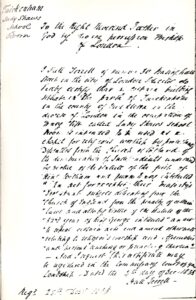
On December 4th 1835 Hull Terrell, Solicitor, made an application to the Bishop of London to register as a place of worship “a certain building situate in the parish of Twickenham in the county of Middlesex in the diocese of London in the occupation of Mary Clift called Lady Shaws school room to be used as a chapel for religious worship by protestant Dissenters …” and this was duly registered on December 28th.

In 1840 the church called its first minister, Benjamin Kluht. Following his ordination service on March 10th 1841, “a number of ministers and friends dined at the George Inn. Sir Robert Shaw presided; and his excellent lady was also present“.

Three years later Lady Shaw gave up some of her garden and advanced the money for the construction of the first chapel: “The foundation stone of a new Independent chapel was laid .. on 10th April 1843. The ceremony was performed by Sir Robert Shaw, Bart, acting for his excellent lady, who has been the principal means, under God, of introducing and sustaining the gospel in the neighbourhood, and who, beside giving the ground on which the chapel will stand, contributes liberally towards its erection.“. The financial side was formalised in the 1848 trust deed, where the trustees accepted liability for a debt of £550, being the sum advanced by her for the construction of the chapel.

The Times, 13th March 1849: “The venerable Sir Robert Shaw expired after a rather brief illness on Saturday evening (10th) at his seat, Bushy-Park, in the County of Dublin, in the 76th year of his age. … He is succeeded in his title and principal estates by his eldest son, Lieutenant-Colonel Robert Shaw, and a portion of the County of Dublin estates, the property of the late Lady Shaw, devolve on the Rt. Hon. Frederick Shaw, as her second son“. The present holder of the title, Sir Robert Shaw, 7th Bart, lives in Calgary, Canada. A manuscript note in the church archives states that quarrels between Lady Shaw and a Mrs Litchfield led to the closing of the chapel for a period in 1849, but more probably this was connected with Sir Robert’s death.

Amelia remained in the house in Twickenham but by 1851 had acquired a house at 10/11 Kensington Gore [subsequently renumbered to 8], a few yards from the site of the Great Exhibition. The Census lists her at this address, aged 60, with two servants also listed. The P.O. London Directory 1851 and 1852 editions Court Directory list her as living at ‘Kensington Gore and Twickenham’. She died at her Kensington home, aged 68, on 11th January 1860 and was buried in the catacombs at Brompton Cemetery (West Bell Tower Catacomb, Vault A)

Unfortunately for the church, Lady Shaw died intestate, with no surviving close relatives. On 28th January 1861 Letters of Administration were granted to Edward Payson, an American farmer who was the sole executor of the will of Penelope Martin, Lady Shaw’s late cousin. The estate was assessed as being just under £10,000 (~£1.5m in 2025). An advertisement in the London Gazette, April 9th 1861, requesting any claims against her estate cites her as ‘Lady Amelia Shaw of No 8, Kensington Gore, London, and of Tay Down House, Brighton’ …. Payson claimed back the money that Lady Shaw had advanced twenty years earlier, temporarily leaving the church in a very uncertain position. Fortunately steps were taken to raise this money and secure the future of the church.


 See ‘The Shaws’, Nathaniel Harris, Dent, 1977, Sir Robert and Lady Shaw’s Marriage: The Times 4th July 1834; Sir Robert Shaw’s obituary: The Times 13th March 1849, Gentlemen’s Magazine May 1849, p.541; Lady Shaw’s obituary: Gentlemen’s Magazine March 1860, p.306

Chapel Next The Green – Into Print

Chapel Next the Green cover

Chapel Next the Green cover

As described last time, I started with the idea of a simple update to a 25-year-old church history  and ended up doing much more. Reading church minute books led to investigating denominational records, the site history, local newspapers and much else. Now it was time to turn my copious notes into a book we could afford to print and which people would find interesting. Having unpicked the story of the dissolution of the church in 1879 and its re-formation in 1882, I suggested a Centenary weekend whose highlight would be the release of my finished history. Now I had a deadline to work to.

In 1979 I was one of the first people to get a home computer, a Commodore PET. I bought a word processing program, name long forgotten, written in BASIC, so customisable. It allowed text to be edited, saved to and retrieved from cassette tape. Output was limited to a monospace font with full space justification. Very limited – the superscript references to footnotes were written in by hand using a Rotring pen – but what a step change from repeatedly retyping manuscripts. Over many weeks I typed up my notes creating the first rough draft.

Centre spread pictures of ministers

Centre spread pictures of ministers

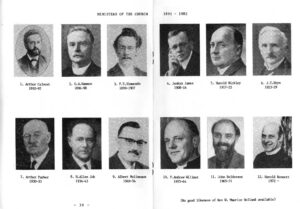
I approached a printer near my office, Emberbrook Print, and explained what I had in mind – a saddle-stitched (stapled) A5 book. Just their sort of job. The church agreed to underwrite the print cost on the basis that selling the print run would return this. This all led to settling on a 72-page book (including covers). The extra cost of the four-page centre photo section was met by a former member. After allowing for prelims, pictures and footnotes, each section would, on average, be limited to around two pages, 800 words. Impossible given the extent of my notes!

For several years my best friends Brian and Margaret Pearce had made me welcome for coffee on Sunday evenings. Now these turned into editorial meetings. Brian, when not working as a college librarian was a writer and poet, and Margaret acted as a fearless editor of his work. Just what I needed! I took the decision to divide my account up by pastorate. A few people criticised this, as placing too much emphasis on the part ministers play in the life of a church, but I hope that my text has the balance right. Over several months, each Sunday morning I handed over a dot-matrix printout of the latest section, vastly over-long yet containing nothing that could be left out (or so I thought). The same evening over coffee I was presented with my edited text, English and punctuation corrected as necessary by Brian, large chunks marked for deletion in red by Margaret. A healthy discussion followed! With some sections this process was repeated several times.

Finally the text was complete but eight lines over length! On a beautifully edited text finding any content that could be removed was hard work, but we managed it. In the meantime a friend’s father, Edmund Heller, took professional photographs of the inside and outside of the church building and my good friend Arthur Burgess organised copies of the obit pictures of former ministers originally printed in Congregation Yearbooks.

Sample of body text

Body text (note the handwritten superscripts!)

Now to the final stage. To keep the price down, the book was to be offset printed from camera-ready copy. This was produced on a Qume daisywheel printer, hired at vast expense from a firm in Old Street, carbon ribbon onto coated paper. I took a week off to produce the page masters. The body text was relatively straightforward, but each page took about ten minutes to print – I watched patiently as the WP program fathomed out each line’s justification. The double column appendices were harder work: the sheet was loaded into the printer and its position carefully marked with a process blue (invisible to a litho camera) pencil before printing the left-hand column. Then it was a question of reloading the paper, lining up the marks and printing the right-hand column. Any previously-missed  error on the output meant another ten minute wait but eventually I had a set of page masters.

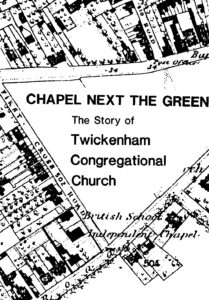
The front cover uses an enlarged extract from the 1863 OS map. The cover text was supplied by Emberbrook in the form of Letraset-style strips (one per line) which removed the need to manually space letters.

Page masters delivered, I waited with a mixture of expectancy and apprehension. I need not have worried: I was (and still am) very pleased with the result, though of course it reflects the technology available to me at the time. For the centenary weekend we invited back all those former members we had contact with and it was a great occasion, with Rev Richard Hall, URC Thames North Moderator preaching at our Sunday morning service. I was touched that with the book being just hours old, he quoted from it in his sermon.

Will a future church history ever be published in book form? 2035 will mark the 200th anniversary of the formation of the church. But the reality is that it’s much easier to assemble a body of knowledge as a series of web pages which can be updated as new information becomes available and which are readily searchable.


The material in Chapel Next the Green can now be read online here

Chapel Next The Green – Research

Chapel Next the Green cover

Chapel Next the Green cover

Forty years ago my history of the Twickenham Congregational Church (Twickenham United Reformed Church from 1972), Chapel Next the Green was published. This post and the one that will follow are about the researching and production of the history respectively, not the history itself. For this refer to the book itself or the church website.

I always had an interest in local history and having grown up in the church I had heard all sorts of stories of its past. Back in 1951 the then church secretary, Reg Peirce, had put together a history to mark what was though to be the church’s triple jubilee (150 years).

Some time in the 1970s I thought that it was time for an updated history and the church meeting agreed to me producing this. I had no background in historical research – at the time I was a council building inspector – and my original plan was to do a relatively quick update to Reg’s history. But I’d started on a journey which would last a good few years.

My starting point was with the church archives, such as they were. These included copies of leaflets, reports and other items of interest (including a programme for the 1902 Centenary Bazaar) and, most importantly, Church Meeting and Deacons Meeting minute books starting with the re-formation of the church in 1882 following a very testing few years. I soon realised I would need to read through these minutes twice: on the first read you get the facts, but because you don’t know what will happen next it’s hard to tell what is or isn’t significant. Needless to say, all this reading and note taking took an extended period.

By now I had a picture of church life from 1882. My next step was to visit the United Reformed Church History Society’s library. Congregation Yearbooks furnished obituaries of the church’s ministers back to the 1850s and sundry other information.

But now I had a problem. Reg’s history (probably based on Andrew Mearns’ 1889 London Congregational Church Directory: “1800 Church formed by B.H.Kluht assisted by Lady Shaw and Dr Leifchild“) left me puzzled. Debrett’s Peerage had failed to provide a suitable Lady Shaw. There was no Rev Kluht active at that time – only one who wasn’t born until 1816. And I’d also found that First Cross Road, where the church stands, was a result of the 1818 Enclosure Award; before this it was part of Twickenham Common.

Lady Shaw's School registered as a place of public worship

Lady Shaw’s School registered as a place of public worship

And then the penny dropped. What if Reg’s history was wrong? Yearbooks from 1862-1884 stated that the church was founded in 1838. All fell into place: Lady Shaw became such on her 1834 marriage to Sir Robert Shaw at Twickenham Parish Church. Benjamin Kluht came to the church as its first minister in 1840. During his seven year pastorate the first chapel was built on land at the rear of Sir Robert and Lady Shaw’s garden.

Then as I widened my research I found the December 1835 certificate of registration of Lady Shaw’s school room as a place of worship which can be taken as the birth date of the church. Now it all made sense.

My research took me to the Greater London Record Office, the Congregational Library at Caroone House, Dr Williams Library, the Guildhall Library, the Public Record Office and British and Foreign School Society Archive. And I made a visit to the elderly Rev Harold Bickley who had become the church’s minister in 1916. The more I knew the more there was to discover. But given that the aim was to publish an updated history, I had to stop somewhere. The decision was made to have a special weekend marking the centenary of the re-formation of the church on 27th April 1882 and so work switched to assembling all my research into a coherent account. Next month I’ll try and recall how this was done.


The material in Chapel Next the Green can now be read online here

1960s Sunday School memories

Although they weren’t churchgoers, my parents – like many others at that time – wanted me to go to Sunday School. A fellow school-gate mum told my mum that the Twickenham Congregational (now United Reformed) church had a good Sunday School. So late in 1959, aged six, I was enrolled. At that time well over 100 children attended each week, most like me having been sent rather than brought.

Each Sunday morning we met in the hall and paraded into church where we sat in our designated pews. Following two hymns and the children’s talk, we adjourned to our classes. After nine months in the primary class I moved up to the junior department which met in the main hall. Demountable screens split the hall into classrooms, each class having around eight children – boys’ classes one side of the hall, girls’ the other. In due course we graduated to the young people’s class, where boys and girls were allowed to mix!

The Sunday School had its own calendar which superimposed the following special events on the regular Sunday morning classes. Roughly speaking it looked like this:

  • Early in the year those of us who wanted to, participated in the National Sunday School Union’s Scripture exam. For six weeks we would study the year’s exam theme and had to learn a memory passage. Then on a Friday evening we all turned up to sit the exam paper. Later a district awards presentation, preceded by a tea, was held at Twickenham Baptist Church. A member of the Baptist church was an amateur printer and produced beautiful Twickenham & District-specific certificates – sadly none of mine survive but here’s an example from Norwich (ack Leo Reynolds)
  • One highlight of the year was the Sunday School festival marked by a fully costumed and staged play. Maurice Stockdale, then Sunday School superintendent, took great pride in producing this. Parts were found for every child who wanted to take place with, by tradition, teachers taking the parts in the last act. We went to rehearsals on six Monday evenings, followed by a Sunday afternoon dress rehearsal (then the obligatory tea!), the performance itself in front of church members and proud parents being on the Monday evening. I just remember playing Elisha’s servant in the play ‘So Small a Thing’ – the healing of Naaman.
  • To June and the Sunday School outing. Back in the early 1960s most people still didn’t have cars so, annual holiday apart, rarely went far, making the outing a great event. Our outing destinations were Oxshott Heath with its enormous sandpit, Frensham Ponds, Box Hill, and for seaside trips, Lancing or Wittering. An elderly near-blind member of the congregation, James Rennie, would give Maurice some money to be shared out towards the end of the outing so that each child could buy some seaside rock or sweets. He would be amazed to know that his simple kindness towards children he didn’t know is still remembered fifty years after his death.
  • Holidays over, September saw promotion Sunday. Everyone who was eligible moved up on the same date, and getting a new teacher was an exciting thing. Even more so, joining the mixed young people’s group!
  • This one I can’t date, but like many children across the world in linked churches we were given collecting boxes to collect donations in support of the London Missionary Society’s John Williams missionary ship which served scattered communities in the southern Pacific. When the John Williams VII ship was commissioned at Tower Pier in 1962 our Sunday School ran an outing to visit her but my parents wouldn’t let me go, scared that I might fall in the Thames!
  • And so to year end. The Christmas family service would invariably include a short nativity play of some sort. Then we’d have a Sunday afternoon Christmas party with games and tea. Aged about nine I can remember my teacher telling me “as it’s the party you can call me Christine instead of Miss Kerslake”! How things have changed!

Within five or so years the practice of non-church parents sending children to Sunday School was no more and numbers sadly collapsed. I’m so grateful to have been part of the preceding generation. So many happy memories of my teachers – Margaret Day, Christine Kerslake, Pat Sparks, John Cragg and Maurice Stockdale. Thanks for all you gave me as a small child.