Category Archives: Twickenham

The church’s founder: Lady Amelia Shaw

Chapel Next the Green (the history of Twickenham Congregational Church) index page

Early accounts of the church history may be inaccurate in many respects but all agree that the formation of the church was due in no small part to Lady Amelia Shaw. The little that is known about her is outlined here.

Lady Shaw was the second wife of Sir Robert Shaw, a Dublin banker and politician of Scottish ancestry.

Sir Robert’s great great grandfather, William Shaw, went to Ireland and fought for King William at the Battle of the Boyne in 1689, and was rewarded by the grant of land there. William’s great grandson, Robert (snr) moved to Dublin in the mid-eighteenth century, prospered as a merchant and became Accountant General of the Post Office. In 1785 he acquired Terenure House, an estate of 35 acres. His eldest son, ‘our’ Robert, was born on 29th January 1774.

On 7th January 1796 Robert married Maria, daughter and heiress of Abraham Wilkinson, and as a dowry received £10,000 together with a 110 acre estate, Bushy Park (possibly named after our local park here in Teddington) which adjoined Terenure House. Six months later Robert Sr. died leaving his son in possession of both estates. He sold Terenure House in 1806 and Bushy Park House became the family home (and was occupied by members of the Shaw family until 1951). See the Bushy Park House and Terenure College Wikipedia pages for more information on these estates.

Robert had a dual career, as a partner in Shaw’s Bank (merged into the Royal Bank of Ireland in 1837) and as a politician. From 1798 he was an MP in the Irish Parliament (voting against the union with England) and served Dublin as its MP at Westminster from 1804-26. He was created a baronet (i.e. becoming Sir Robert) on 17 August 1821, being formally invested by George IV when he visited Ireland in 1822.

Maria died in 1831 having borne nine children. Sir Robert’s cousin, Bernard Shaw, had died in 1826 and Sir Robert had provided Bernard’s widow, Frances, with a cottage on the Terenure estate where she lived for the next 45 years. One of Frances’ grandchildren, George Bernard Shaw, was to be a regular visitor. On several occasions Sir Robert proposed to Frances, but he was turned down each time

… and now to matters of more local interest

The Times, Friday July 4th 1834: “On Wednesday the 2d inst, at Twickenham [Parish] Church, by the Rev Mr Snow, Sir Robert Shaw, Bart of Bushy-Park, County of Dublin, to Amelia Spencer of Twickenham, daughter of the late Benjamin Spencer MD, formerly of Bristol“. Dissenters would only be allowed to be married in their own chapels after the passing of the Marriage Act 1836. Amelia, in her early forties became the second Lady Shaw. Part of the marriage settlement involved the purchase of a house in Twickenham (see the church site) which was placed in trust for her (at this time married women could not own property). The trustees were Frederick Shaw (second son of Sir Robert), Henry Pownall (local landowner and owner of much of the Great Tithe) and John Bridges.

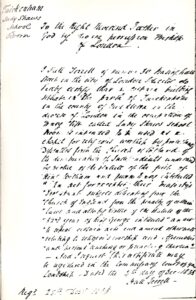
On December 4th 1835 Hull Terrell, Solicitor, made an application to the Bishop of London to register as a place of worship “a certain building situate in the parish of Twickenham in the county of Middlesex in the diocese of London in the occupation of Mary Clift called Lady Shaws school room to be used as a chapel for religious worship by protestant Dissenters …” and this was duly registered on December 28th.

In 1840 the church called its first minister, Benjamin Kluht. Following his ordination service on March 10th 1841, “a number of ministers and friends dined at the George Inn. Sir Robert Shaw presided; and his excellent lady was also present“.

Three years later Lady Shaw gave up some of her garden and advanced the money for the construction of the first chapel: “The foundation stone of a new Independent chapel was laid .. on 10th April 1843. The ceremony was performed by Sir Robert Shaw, Bart, acting for his excellent lady, who has been the principal means, under God, of introducing and sustaining the gospel in the neighbourhood, and who, beside giving the ground on which the chapel will stand, contributes liberally towards its erection.“. The financial side was formalised in the 1848 trust deed, where the trustees accepted liability for a debt of £550, being the sum advanced by her for the construction of the chapel.

The Times, 13th March 1849: “The venerable Sir Robert Shaw expired after a rather brief illness on Saturday evening (10th) at his seat, Bushy-Park, in the County of Dublin, in the 76th year of his age. … He is succeeded in his title and principal estates by his eldest son, Lieutenant-Colonel Robert Shaw, and a portion of the County of Dublin estates, the property of the late Lady Shaw, devolve on the Rt. Hon. Frederick Shaw, as her second son“. The present holder of the title, Sir Robert Shaw, 7th Bart, lives in Calgary, Canada. A manuscript note in the church archives states that quarrels between Lady Shaw and a Mrs Litchfield led to the closing of the chapel for a period in 1849, but more probably this was connected with Sir Robert’s death.

Amelia remained in the house in Twickenham but by 1851 had acquired a house at 10/11 Kensington Gore [subsequently renumbered to 8], a few yards from the site of the Great Exhibition. The Census lists her at this address, aged 60, with two servants also listed. The P.O. London Directory 1851 and 1852 editions Court Directory list her as living at ‘Kensington Gore and Twickenham’. She died at her Kensington home, aged 68, on 11th January 1860 and was buried in the catacombs at Brompton Cemetery (West Bell Tower Catacomb, Vault A)

Unfortunately for the church, Lady Shaw died intestate, with no surviving close relatives. On 28th January 1861 Letters of Administration were granted to Edward Payson, an American farmer who was the sole executor of the will of Penelope Martin, Lady Shaw’s late cousin. The estate was assessed as being just under £10,000 (~£1.5m in 2025). An advertisement in the London Gazette, April 9th 1861, requesting any claims against her estate cites her as ‘Lady Amelia Shaw of No 8, Kensington Gore, London, and of Tay Down House, Brighton’ …. Payson claimed back the money that Lady Shaw had advanced twenty years earlier, temporarily leaving the church in a very uncertain position. Fortunately steps were taken to raise this money and secure the future of the church.


 See ‘The Shaws’, Nathaniel Harris, Dent, 1977, Sir Robert and Lady Shaw’s Marriage: The Times 4th July 1834; Sir Robert Shaw’s obituary: The Times 13th March 1849, Gentlemen’s Magazine May 1849, p.541; Lady Shaw’s obituary: Gentlemen’s Magazine March 1860, p.306
Three prominent members

Chapel Next the Green (the history of Twickenham Congregational Church) index page

In March, April and May 1998 the church newsletter carried short biographies of the three members known to have appeared in the pages of Who’s Who and they are reproduced below.

But to place them in context, first read my editorial from the May 1998 newsletter:

As soon as I finished writing the first of the three mini biographies of former members who made the pages of Who’s Who, I realised that this might be open to misinterpretation – does it look like name dropping or imply that we value some people more than others? This was certainly not my intention.

I think that it is more than coincidental that all three were among the 62 people to join our church during the eventful pastorate of F.T.Simmonds (our minister from 1899-1907). Before then the recognisable names on our membership roll are those of local shopkeepers and tradesmen. At the turn of the century new development brought in those engaged in middle class occupations, and the nature of the area – reflected in the membership of our church – changed, not for the first or last time.

When I was a young person, it seemed that most of our church members were civil servants, teachers or nurses; now, as in late Victorian times, we also have a number of members who run their own small businesses. If this newsletter has come through your letterbox, rest assured that we are all just ordinary people like you and your neighbours, and you would, we hope, feel at home among us if you wished to join us one Sunday.

But what of the other 59 members who joined our church during Mr Simmonds’ pastorate? Some we know about, indeed some our older members may remember a few of them, but most are now forgotten – but this does not mean that their contribution to their church and community was any less valuable. In the past Janet Lees has reminded us about some of the un-named women who play a key part in the Bible narrative – and there are many men too. So too in our century.

More than forty years ago a French priest, Michel Quoist, wrote a book called ‘Prayers of Life’. On of the meditations is called ‘The Brick’. It ends:

“I thought, Lord, of that brick buried in the darkness at the base of that big building. No one sees it, but it accomplishes its task and the other bricks need it. Lord what difference whether I am on the roof-top or in the foundations, as long as I stand faithfully at the right place?”

May we each be ready to faithfully serve in the place God has given us, whether in the public eye or not.

Tony Bryer

John Allen Harker, 1870-1923

John Allen Harker CBE D.Sc. was born in Alston, Cumbria, in 1870 where his father was Congregational minister. After school in Stockport (his father moved there in 1871), he then studied at Manchester and Tübingen (Germany) universities. He came to work at the National Physical Laboratory, Teddington, rising to Chief Assistant and Head of Thermometry. From 1916 he was Director of Research at the Ministry of Munitions. He wrote scientific papers, served on government committees and visited the USA and Canada on behalf of the British government. He was on board the Cunard liner Andania when it was torpedoed off the Irish coast in January 1918 with a loss of seven lives. In 1921 he went into private practice, but died in 1923 aged just 53.

Dr & Mrs Harker lived in Teddington, firstly in Kingston Road, then moving to ‘Alston’, Queens Road: we may guess that he named the house (still there) after his birthplace.

Dr Harker’s delightful account of his first visit to our church (1903?) appears in my church history, ‘Chapel Next the Green’: “Good Mr Purchase was in the porch smiling and gave him a hymn book and showed him into a seat. He did not remember what the sermon was about, and there was not a large congregation, and it was not a grand service, but he went home and told his wife, and after his wife had been to a service, he didn’t know which of them was the more delighted“.

Both became church members in May 1904, just after he had been elected to the Church Committee (which from 1903-9 took the place of the Diaconate); subsequently they both played an active part in church life until around 1920-21 by which time they had moved from the area. Dr Harker’s church membership was formally transferred to Whitefield’s Memorial Church in December 1921


Peter Galloway Fraser, 1862-1925

The second of our three members to appear in Who’s Who, [Peter] Galloway Fraser JP is the one of whom least is known. As you might guess, he was a Scot, who came to London as a Parliamentary reporter for the Dundee Chronicle. In 1890 he went to work for George Newnes, ultimately becoming editor of ‘Tit-Bits‘. In 1899 he moved from Putney to 13 Strawberry Hill Road where he and his wife lived until his death in September 1925.

Mr Fraser joined the church in 1904 (on the same day as Dr John Harker), having been elected to the Church Committee the year before. He served on the Committee until 1906 but does not appear to have held any other church office after this.

On his death, fellow editor and church member, J.H.Broad, recorded in the Richmond & Twickenham Home Journal, “His editorship of Tit-Bits was perhaps his most outstanding position … Since his retirement he has taken extensive interest in local affairs and has occupied some very important positions [unfortunately not detailed]. Twickenham has lost a most capable and loveable gentleman“. In contrast, the Richmond & Twickenham Times [3.10.25] felt that “the fact that he was at one time editor of Tit Bits, not generally regarded as a serious weekly production, does not convey any idea of his abilities … His best efforts appeared in the Scottish papers“. Does anyone know more about him?


Clifford Copeland Patterson, 1879-1948

In contrast to my previous two subjects, there is no shortage of material about the last of the three members to appear in Who’s Who. Sir Clifford Copeland Paterson, son of a tanner and leather merchant, was born in Stoke Newington in 1879. After school he trained in general and electrical engineering then came to the newly established NPL in 1903, specialising in light and lighting. He was awarded an OBE in 1916 for his work on the Paterson-Walsh aircraft height finder.

Mr and Mrs Paterson joined the church in 1906, on transfer from Stamford Hill. They lived at 28 Clifden Road, then 10 Walpole Gardens. Both were keen sailors and gardeners. He served as Sunday School Superintendent (383 children in 1908!), Church Secretary from 1907-1916 and was a Deacon until moving to Oxhey in 1923.

In 1916 the Osram Lamp Works in Hammersmith invited Mr Paterson to set up a research department for them (before the war they had depended on German technology), but he was not free to accept such a post during the war. Five days after the Armistice, Hugo (later Lord) Hirst, a founder of GEC asked him to become founder director of the GEC Research Laboratories (GEC having taken over Osram), a post he held until his death in July 1948.

The labs were initially housed at Hammersmith, 71 staff moving to a purpose- built facility in North Wembley in 1922. Work on filament lamps naturally developed into electronic valves. During World War II the staff grew to more than a thousand and the work on searchlights, camouflage, radio, and radar was to play a key part in the war effort, rewarded by a knighthood in 1946.

Mr Paterson was President of the Institution of Electrical Engineers 1930-1 and was made a Fellow of the Royal Society in 1942: they now hold an annual Clifford Paterson lecture. ‘The GEC Research Laboratories 1919-84‘ and ‘A Scientist’s War – the war diary of Sir Clifford Paterson, 1939-45‘, both by Clayton & Algar, detail his scientific work. as does the 21-page obituary published by the Royal Institution. The latter notes the influence of his Christian faith on the way in which he ran the GEC labs, seeking to create an culture of co-operation and partnership.


Last updated 26 July 2025

The King’s Arms Public House, Albion Road, Twickenham

These notes were compiled by Vic Rosewarne during the 1990s. Vic was a member and later Chairman of the Borough of Twickenham Local History Society

The King’s Arms was one of the first Beer Houses opened in Twickenham following the Beer House Act of 1830. This Act permitted any householder, who paid domestic rates, to buy a licence from the Customs and Excise and open his or her house for the sale of beer and cider only. The licence initially cost two guineas, later rising to five.

Originally run by Radford Parpworth, who was also a builder and carpenter, it was taken over by David Healey around 1854. He had previously run the Prince Albert Beer House in Hounslow Road, Whitton. After his death, in about 1865, it was run by his wife, Sophia, and later his son Walter until 1933. In 1870 the licence was in danger of being lost as the house was thought by the licensing magistrates to be of insufficent value; alterations and extensions were then made which brought the rateable value up. The present building was erected on the site of the previous house in 1926.


See also: The Duke’s Head

The Duke’s Head Public House, Twickenham

These notes were compiled by Vic Rosewarne during the 1990s. Vic was a member and later Chairman of the Borough of Twickenham Local History Society

The Duke’s Head, Colne Road (prev. Albion Road), Twickenham

This house was first recorded 1759, when Joseph Parrott was licensee, although he is recorded by 1750 as having a house in Twickenham, but no sign is then given. The land on which the pub stands was enclosed from Hounslow Heath by 1740, along with other areas south of Colne Road. The original house fronted on Albion Road and before the enclosures this was the edge of the Heath. The house then had a large bay window in the front from which the comings and goings on the Heath could be seen. Like most pubs on Hounslow Heath it is said Dick Turpin stayed there, indeed it is claimed he hid from his pursuers in the cellars, and whilst there carved his name on the cellar door.

The present building, fronting on Colne Road, was erected in 1914 in the backyard of the old house, this then becoming a private house, which was demolished post war. Albion Road was known as Duke’s Head Row until 1878, when the local Board renamed many of the Roads.


See also: The King’s Arms

Chapel Next The Green – Into Print

Chapel Next the Green cover

Chapel Next the Green cover

As described last time, I started with the idea of a simple update to a 25-year-old church history  and ended up doing much more. Reading church minute books led to investigating denominational records, the site history, local newspapers and much else. Now it was time to turn my copious notes into a book we could afford to print and which people would find interesting. Having unpicked the story of the dissolution of the church in 1879 and its re-formation in 1882, I suggested a Centenary weekend whose highlight would be the release of my finished history. Now I had a deadline to work to.

In 1979 I was one of the first people to get a home computer, a Commodore PET. I bought a word processing program, name long forgotten, written in BASIC, so customisable. It allowed text to be edited, saved to and retrieved from cassette tape. Output was limited to a monospace font with full space justification. Very limited – the superscript references to footnotes were written in by hand using a Rotring pen – but what a step change from repeatedly retyping manuscripts. Over many weeks I typed up my notes creating the first rough draft.

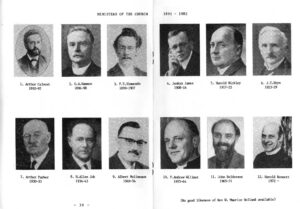
Centre spread pictures of ministers

Centre spread pictures of ministers

I approached a printer near my office, Emberbrook Print, and explained what I had in mind – a saddle-stitched (stapled) A5 book. Just their sort of job. The church agreed to underwrite the print cost on the basis that selling the print run would return this. This all led to settling on a 72-page book (including covers). The extra cost of the four-page centre photo section was met by a former member. After allowing for prelims, pictures and footnotes, each section would, on average, be limited to around two pages, 800 words. Impossible given the extent of my notes!

For several years my best friends Brian and Margaret Pearce had made me welcome for coffee on Sunday evenings. Now these turned into editorial meetings. Brian, when not working as a college librarian was a writer and poet, and Margaret acted as a fearless editor of his work. Just what I needed! I took the decision to divide my account up by pastorate. A few people criticised this, as placing too much emphasis on the part ministers play in the life of a church, but I hope that my text has the balance right. Over several months, each Sunday morning I handed over a dot-matrix printout of the latest section, vastly over-long yet containing nothing that could be left out (or so I thought). The same evening over coffee I was presented with my edited text, English and punctuation corrected as necessary by Brian, large chunks marked for deletion in red by Margaret. A healthy discussion followed! With some sections this process was repeated several times.

Finally the text was complete but eight lines over length! On a beautifully edited text finding any content that could be removed was hard work, but we managed it. In the meantime a friend’s father, Edmund Heller, took professional photographs of the inside and outside of the church building and my good friend Arthur Burgess organised copies of the obit pictures of former ministers originally printed in Congregation Yearbooks.

Sample of body text

Body text (note the handwritten superscripts!)

Now to the final stage. To keep the price down, the book was to be offset printed from camera-ready copy. This was produced on a Qume daisywheel printer, hired at vast expense from a firm in Old Street, carbon ribbon onto coated paper. I took a week off to produce the page masters. The body text was relatively straightforward, but each page took about ten minutes to print – I watched patiently as the WP program fathomed out each line’s justification. The double column appendices were harder work: the sheet was loaded into the printer and its position carefully marked with a process blue (invisible to a litho camera) pencil before printing the left-hand column. Then it was a question of reloading the paper, lining up the marks and printing the right-hand column. Any previously-missed  error on the output meant another ten minute wait but eventually I had a set of page masters.

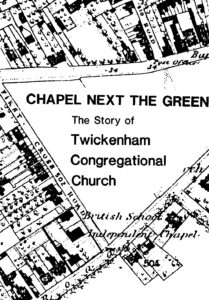
The front cover uses an enlarged extract from the 1863 OS map. The cover text was supplied by Emberbrook in the form of Letraset-style strips (one per line) which removed the need to manually space letters.

Page masters delivered, I waited with a mixture of expectancy and apprehension. I need not have worried: I was (and still am) very pleased with the result, though of course it reflects the technology available to me at the time. For the centenary weekend we invited back all those former members we had contact with and it was a great occasion, with Rev Richard Hall, URC Thames North Moderator preaching at our Sunday morning service. I was touched that with the book being just hours old, he quoted from it in his sermon.

Will a future church history ever be published in book form? 2035 will mark the 200th anniversary of the formation of the church. But the reality is that it’s much easier to assemble a body of knowledge as a series of web pages which can be updated as new information becomes available and which are readily searchable.


The material in Chapel Next the Green can now be read online here

Chapel Next The Green – Research

Chapel Next the Green cover

Chapel Next the Green cover

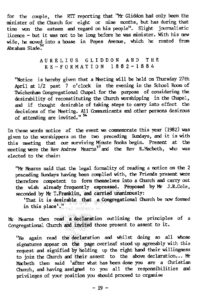
Forty years ago my history of the Twickenham Congregational Church (Twickenham United Reformed Church from 1972), Chapel Next the Green was published. This post and the one that will follow are about the researching and production of the history respectively, not the history itself. For this refer to the book itself or the church website.

I always had an interest in local history and having grown up in the church I had heard all sorts of stories of its past. Back in 1951 the then church secretary, Reg Peirce, had put together a history to mark what was though to be the church’s triple jubilee (150 years).

Some time in the 1970s I thought that it was time for an updated history and the church meeting agreed to me producing this. I had no background in historical research – at the time I was a council building inspector – and my original plan was to do a relatively quick update to Reg’s history. But I’d started on a journey which would last a good few years.

My starting point was with the church archives, such as they were. These included copies of leaflets, reports and other items of interest (including a programme for the 1902 Centenary Bazaar) and, most importantly, Church Meeting and Deacons Meeting minute books starting with the re-formation of the church in 1882 following a very testing few years. I soon realised I would need to read through these minutes twice: on the first read you get the facts, but because you don’t know what will happen next it’s hard to tell what is or isn’t significant. Needless to say, all this reading and note taking took an extended period.

By now I had a picture of church life from 1882. My next step was to visit the United Reformed Church History Society’s library. Congregation Yearbooks furnished obituaries of the church’s ministers back to the 1850s and sundry other information.

But now I had a problem. Reg’s history (probably based on Andrew Mearns’ 1889 London Congregational Church Directory: “1800 Church formed by B.H.Kluht assisted by Lady Shaw and Dr Leifchild“) left me puzzled. Debrett’s Peerage had failed to provide a suitable Lady Shaw. There was no Rev Kluht active at that time – only one who wasn’t born until 1816. And I’d also found that First Cross Road, where the church stands, was a result of the 1818 Enclosure Award; before this it was part of Twickenham Common.

Lady Shaw's School registered as a place of public worship

Lady Shaw’s School registered as a place of public worship

And then the penny dropped. What if Reg’s history was wrong? Yearbooks from 1862-1884 stated that the church was founded in 1838. All fell into place: Lady Shaw became such on her 1834 marriage to Sir Robert Shaw at Twickenham Parish Church. Benjamin Kluht came to the church as its first minister in 1840. During his seven year pastorate the first chapel was built on land at the rear of Sir Robert and Lady Shaw’s garden.

Then as I widened my research I found the December 1835 certificate of registration of Lady Shaw’s school room as a place of worship which can be taken as the birth date of the church. Now it all made sense.

My research took me to the Greater London Record Office, the Congregational Library at Caroone House, Dr Williams Library, the Guildhall Library, the Public Record Office and British and Foreign School Society Archive. And I made a visit to the elderly Rev Harold Bickley who had become the church’s minister in 1916. The more I knew the more there was to discover. But given that the aim was to publish an updated history, I had to stop somewhere. The decision was made to have a special weekend marking the centenary of the re-formation of the church on 27th April 1882 and so work switched to assembling all my research into a coherent account. Next month I’ll try and recall how this was done.


The material in Chapel Next the Green can now be read online here

1960s Sunday School memories

Although they weren’t churchgoers, my parents – like many others at that time – wanted me to go to Sunday School. A fellow school-gate mum told my mum that the Twickenham Congregational (now United Reformed) church had a good Sunday School. So late in 1959, aged six, I was enrolled. At that time well over 100 children attended each week, most like me having been sent rather than brought.

Each Sunday morning we met in the hall and paraded into church where we sat in our designated pews. Following two hymns and the children’s talk, we adjourned to our classes. After nine months in the primary class I moved up to the junior department which met in the main hall. Demountable screens split the hall into classrooms, each class having around eight children – boys’ classes one side of the hall, girls’ the other. In due course we graduated to the young people’s class, where boys and girls were allowed to mix!

The Sunday School had its own calendar which superimposed the following special events on the regular Sunday morning classes. Roughly speaking it looked like this:

  • Early in the year those of us who wanted to, participated in the National Sunday School Union’s Scripture exam. For six weeks we would study the year’s exam theme and had to learn a memory passage. Then on a Friday evening we all turned up to sit the exam paper. Later a district awards presentation, preceded by a tea, was held at Twickenham Baptist Church. A member of the Baptist church was an amateur printer and produced beautiful Twickenham & District-specific certificates – sadly none of mine survive but here’s an example from Norwich (ack Leo Reynolds)
  • One highlight of the year was the Sunday School festival marked by a fully costumed and staged play. Maurice Stockdale, then Sunday School superintendent, took great pride in producing this. Parts were found for every child who wanted to take place with, by tradition, teachers taking the parts in the last act. We went to rehearsals on six Monday evenings, followed by a Sunday afternoon dress rehearsal (then the obligatory tea!), the performance itself in front of church members and proud parents being on the Monday evening. I just remember playing Elisha’s servant in the play ‘So Small a Thing’ – the healing of Naaman.
  • To June and the Sunday School outing. Back in the early 1960s most people still didn’t have cars so, annual holiday apart, rarely went far, making the outing a great event. Our outing destinations were Oxshott Heath with its enormous sandpit, Frensham Ponds, Box Hill, and for seaside trips, Lancing or Wittering. An elderly near-blind member of the congregation, James Rennie, would give Maurice some money to be shared out towards the end of the outing so that each child could buy some seaside rock or sweets. He would be amazed to know that his simple kindness towards children he didn’t know is still remembered fifty years after his death.
  • Holidays over, September saw promotion Sunday. Everyone who was eligible moved up on the same date, and getting a new teacher was an exciting thing. Even more so, joining the mixed young people’s group!
  • This one I can’t date, but like many children across the world in linked churches we were given collecting boxes to collect donations in support of the London Missionary Society’s John Williams missionary ship which served scattered communities in the southern Pacific. When the John Williams VII ship was commissioned at Tower Pier in 1962 our Sunday School ran an outing to visit her but my parents wouldn’t let me go, scared that I might fall in the Thames!
  • And so to year end. The Christmas family service would invariably include a short nativity play of some sort. Then we’d have a Sunday afternoon Christmas party with games and tea. Aged about nine I can remember my teacher telling me “as it’s the party you can call me Christine instead of Miss Kerslake”! How things have changed!

Within five or so years the practice of non-church parents sending children to Sunday School was no more and numbers sadly collapsed. I’m so grateful to have been part of the preceding generation. So many happy memories of my teachers – Margaret Day, Christine Kerslake, Pat Sparks, John Cragg and Maurice Stockdale. Thanks for all you gave me as a small child.

Twickenham Ferry

Last week a Melbourne Maritime Heritage Network meeting discussed Melbourne’s Ferries – Past, Present and Future. Upstream of the city all the ferries across the Yarra – one of which I will return to – have been replaced by bridges. Downstream, the river is subject to a fairly low speed limit, reflecting the use of the river by small leisure craft, container ships accessing the docks as well as the need to protect of the river banks. Geography means that for most destinations, unlike Sydney, other forms of transport are quicker or cheaper.

Bellarine Express and Geelong Flyer ferries passing in Victoria Harbour

Bellarine Express and Geelong Flyer ferries passing in Victoria Harbour

Apart from the tourist ferries from the CBD to Williamstown, we do have two ferries running from here in Docklands to Portarlington and Geelong, both services starting in the last few years. Portarlington  in particular lends itself to a ferry service – it’s not served by rail and the ferry is probably quicker than driving. Will we see more ferries? Not without suitable mooring facilities, the meeting was told.

But back to Ferries past. When the first settlers came here they brought a lot of their former place names with them. So as a one-time resident of Twickenham, now living in Docklands, I can easily visit Richmond, Hampton, Sunbury but no Twickenham. We do though have a Twickenham Crescent in Burnley. Why? Let the Australasian, 4 June 1904 explain:

TWICKENHAM FERRY

Extract from 1889 David Syme woodcut: Twickenham Ferry on the Yarra

Extract from 1889 David Syme woodcut: Twickenham Ferry on the Yarra

One of the prettiest reaches on the Yarra, within easy distance from Melbourne, is that portion lying between Burnley and Toorak, about 4 1/2 miles up from Prince’s bridge. Here a ferry conveys passengers across the river, starting at the bottom of Grange-road, Toorak, across to Burnley. The ferry dates back to 1880, when Jesse Harrow, a veteran waterman, founded it.Unlike its English namesake on the River Thames, where the ferryboat is manned by a “jolly young waterman,” Twickenham Ferry on the Yarra is worked by means of a suspended rope, stretched across the river*, with a sheave wheel and regulating lines at each end, so that it can be raised or lowered, according to the height of the water.

Twickenham Ferry postcard c.1907

Twickenham Ferry postcard c.1907

On the Burnley side of the river, partly hewn out of the bank, is constructed a most picturesque old dwelling, containing four rooms and a shop. Here the widow of the late Jesse Barrow, together with her son and daughter reside, and retail refreshments, ranging from soft drinks and kola beer to apples, pears, and lollies, to the thirsty oarsmen. The ferry hours during the weekdays are from 7 in the morning till 10 at night, and on Sundays from 8 till 9, the fare being one penny each way.

“There are a good many ‘dead heads,’ though,” added the ferryman; “you see sometimes, men looking for work, want to cross the river, and, of course, promise to pay when they return, and again sometimes a lady finds she has left her purse at home, or has no change; then we have to trust to their honesty. So it’s not all profit, in addition, we have to pay £5 a year for a license.”

Thirty years later the ferry service was no more:

FAREWELL TO TWICKENHAM FERRY

Not least perhaps among the many functions which his Grace the Duke of Gloucester will perform will be the official opening of the Centenary Bridge at Grange Road, well on the way to completion. Another step in the path of progress no doubt; but progress, no matter how desirable in practical ways, is not always a source of unalloyed gratification. At least, so thinks Mr. Barrow, the picturesque boatman of Twickenham Ferry, who, with the opening of the bridge, will find his occupation, like Othello’s, gone. Incidentally another, perhaps one of the last of those links that bind us to Melbourne’s pioneer days, will be broken.

Mr. Barrow, who has lived in or near his present habitation, Twickenham Ferry, just by Burnley, throughout his life, is the son of Jesse Barrow, who came to Australia from England in 1861….

None of the many regular or casual voyagers carried in his little craft during nearly half a century ever made an un-interesting trip with Mr. Barrow. Short though the transit might be, there was always time for some interesting reminiscence that gave additional interest or charm to an already charming spot. The strong structure that makes his service “no longer necessary” will be stolidly silent where he was eloquent, retaining its frigid parvenu dignity somewhat in-appropriately in the midst of rustic beauty. But though Mr. Barrow’s services will be no longer required, we in Melbourne know, they will not be forgotten

Argus 15 Sept 1934

Swimming in the 1960s

I was not a water baby. It took me a long time to learn to swim but thankfully I did. Back in 1863 Abraham Slade recorded:

July 14th. 1863. My poor dear Arthur aged 9 years : About 6 in the evening went alone to bathe in the river near Whitton, and got into a deep hole and lost his life, was brought home quite dead. Was buried in Twickenham Burial Ground on the 18th Saturday afternoon… Oh the anguish of soul it has caused his parents…

Thankfully as a child growing up in Twickenham I had many better, safer options. My first vague memory of public swimming pools is from the early 1960s. Keen that I should learn to swim, I was enrolled in Saturday morning swimming lessons at the old (1882) Richmond swimming pool in Parkshot, Richmond, by then showing its age. Changing cubicles lined both sides of the pool. We went there because the then Borough of Twickenham didn’t have an indoor pool. There I learned to swim!

At primary school we had swimming lessons – memories are vague, but perhaps just during our last two years? A green Fountains coach would take us to Isleworth Baths (1936) and back to school afterwards. Outside school, I don’t remember going swimming very often: I never ever swam at the massive Twickenham Lido but would go to the then outdoor Teddington pool on hot summer days. Of the Twickenham baths, derelictlondon.com says

Built in the 1930s, in a concrete and brick art deco style, Twickenham Baths was municipal architecture in the grand sense with its wide hall, twin staircase and deep arches… The pool itself was an old-fashioned Lido, the last word in leisure, generously proportioned and with ample room for sunbathing on the paved areas. There were fountains at each end of the pool and a diving board at its deepest point, in the middle

Then to Hampton Grammar School. During my first few years during the summer term we would go swimming once a week at the outdoor Hampton pool, then unheated. If the water temperature was 10C (!) or more, it was deemed suitable for swimming.

Later in my school career we were given a wider choice of activities on games afternoon. Not being keen on the mud and cold of football, I opted for swimming. We were left to make our own way from school to the near-new (1965) Feltham baths by bike (c.3 miles, 10 mins), where our names were ticked off by Mr Pickering, supervising master who had driven there and would spend the session sitting in gallery catching up with marking. Once the allotted time was up we were left to get changed and make our own way home. Today there’s no way any school would be allowing its pupils to go off unsupervised, and I can’t imagine many parents would allow it either. The interesting thing about this pool was a movable boom which could be placed at one end to give a full-length pool or moved out to create a separate diving pool (in those days pools had springboards and high diving boards).

As the truly excellent Lidos Alive pages recount, the pools of my childhood are no more. In 1966 Richmond Parkshot was replaced by a new pool complex in Old Deer Park. The 1936 Isleworth pool and Library has been rebuilt as Isleworth Recreation Centre. Teddington, originally built as a lido pool in 1931, was closed in 1976 and rebuilt as an indoor facility in 1978. Hampton Pool was closed by LBRuT in 1981, then reopened following community pressure. It’s run by Hampton Pool Trust, a non-profit It’s still an outdoor pool, rebuilt in 2004, but the water is now maintained at a year-round temperature of around 28 degrees – such luxury compared with our 1960s 10C! Feltham baths is now Hanworth Air Park Leisure Centre & Library.

Twickenham Baths is the one that has disappeared. It was closed in 1980 and the site stood derelict for years. The old swimming pool was filled in and all buildings demolished in 2005. 41 years later the long term future of the site still has to be determined.

And now? The building in which I live has a beautiful 25m pool which I ought to use but rarely do. This winter I must make the effort to do so.

On Maths Teachers

Last Saturday saw the annual City Bible Forum ‘Life at Work’ conference. With the uncertainties of Covid-19 this year’s conference had to be a virtual one over Zoom. Whilst some of us in Melbourne missed the excellent food served up by our usual hosts, CQ Functions, many others away from capital cities were able to participate. One speaker was Eddie Woo, committed Christian and maths teacher extraordinaire. His YouTube channel, WooTube, started with him filming class lessons for a sick student in 2012, and it now has over 1.1 million subscribers. For his work he was made Australian Local Hero of the Year 2018 – a well deserved honour.

As for my own school maths teachers, they may never got to be known outside their local circles, but thanks to them I’ve spent 30+ years writing engineering software with more than a little maths. I owe them all a great debt.

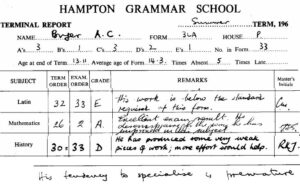
Extract from Hampton Grammar School report

The facts do indeed justify the conclusion!

Two from Hampton Grammar School stand out. It’s an institution I carry less than fond memories of and yet I remember many individual teachers with affection.

Maths was my strong subject as this report extract shows (I’m not sure why this term’s class ranking was so low). Unfortunately I didn’t apply myself to most other subjects.

For O-level maths our teacher was the elderly (to us schoolboys) Frank Steffens. He was an old boy of the school having been Head Boy c.1924-5. He went off to university, then returned to HGS to spend the rest of his working life as a maths teacher. His apparent sternness disguised a kindly nature. He wanted every boy in his class to succeed and we did. I’m not sure whether today’s teachers would be allowed to make the weakest pupils of the week sit in the front row on the following week, but it was a tactic that worked!

I was in the ‘Latin A’ [express] stream which meant that we took our O-levels after four years instead of five; for maths we took the ordinary exam in January followed by Additional Maths in June. There were 32 of us in the class (not streamed for maths); 28 of us got a grade A in the O-level, 4 got B’s and 4 C’s (when pass grades were A-E), an extraordinary achievement. Later, in the sixth form Mr Steffens took us for a general studies class. Us boys were amazed that someone so ancient (he would have been in his early 60s!) could understand and explain to us the science behind Dolby stereo!

We started our A-level studies under Stan Barton, who was also Deputy Head. With an interregnum between heads, he was often called away and so would set work for us to get on with in his absence. Not too much work was being done when Alan Waltham, head of maths, happened to walk by the classroom and hearing our chatter decided to investigate. He decided that it would be best if our group could sit in his classroom and get on with our work while he taught his main class, breaking off occasionally to check on our progress. Finding that four of us were well ahead of the others he offered to coach us to sit pure and applied maths as two subjects rather than sit the combined paper, an offer which we accepted. And so this left him teaching three different groups at the same time! And we all passed!

Then to Reading University: No specific maths classes but in my last year those of us in the Building Surveying stream had a weekly structural engineering class. It was the high spot of my week, not so for most of my fellow students. Our lecturer, Mike Hewitt, owned a calculator which could calculate sines and cosines! We were in awe of this device which had cost him a couple of months salary. We did our calculations with slide rules! He understood that some were not mathematically inclined: “In the exam there will be seven questions and you have to do five. 4½ will be mathematical questions and 2½ essay questions [i.e. one half-and-half]. That’s so those of you who can’t add up 2+2 can at least pass on the essay questions and the clever buggers among you [looking at me] can’t get 100%”. He’d be pleased, I hope, to see what this ‘clever bugger’ has been doing for most of his working life.