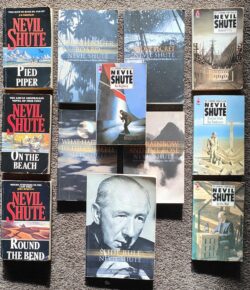
 My book cull continues. During the last few weeks I’ve speed-read all my Nevil Shute novels, my favoured inflight entertainment before plane seatback screens became the norm, and soon they’ll be off to the op-shop.
Nevil Shute Norway (1899-1960) was an English (later Australian) author and aeronautical engineer. He published his novels as Nevil Shute, fearing that using his full name would adversely affect his engineering career.
In 1919, after serving in WW1, he went up to Oxford, Balliol College, where he gained a third class degree in engineering. He began his engineering career with the newly-formed de Havilland company, moving on to Vickers Ltd in 1924 as principal assistant (“Chief Calculator”) to Barnes Wallis on the R100 airship programme. Under the Imperial Airship programme the R100 and government-run R101 airships were built in competition to each other. “It was generally agreed in 1924 that the aeroplane would never be a very suitable vehicle for carrying passengers across the oceans, and that airships would operate all the long-distance routes of the future”. Thus the government interest,
After the R101 crashed over northern France in October 1930 with all lives lost, the programme was put on hold whilst the fate of the R100 was decided. In December 1931, she was broken up and sold for scrap. With A.H.Tiltman, a noted aeroplane designer, Shute established Airspeed Limited to build aeroplanes in York, England. WW2 saw him join the Royal Naval Volunteer Reserve, where he served until 1944.
Shute’s first published novel, Marazan, was published in 1926. His novels draw extensively on his rich experience of aero engineering, sailing, model engineering, naval service and travel.
Feeling “oppressed by British taxation“, In 1950 Shute, with his wife and two daughters, moved to Australia building a home on farmland at Langwarrin, south-east of Melbourne. During the next ten years leading up to his death he became one of the world’s best-selling novelists. Read about his Langwarrin home here.
The books
Of his twenty-four published novels I’ve now got twelve which have I’ve re-read in recent weeks. For a full list check out the Nevil Shute Norway foundation website. Here are a few of note:
Ruined City (1938) This was my first introduction to Shute, in a university economics class 50 years ago, used as an introduction to the multiplier effect. A shipyard in northern England fails and takes the rest of the town with it. Then the reverse happens.
What Happened to the Corbetts (April 1939) is a fictional depiction of the effect of aerial bombing on the British city of Southampton. It wouldn’t be long before this would no longer be fiction.
No Highway (1948) The hero of the story, Theodore Honey, is a middle-aged widower who works at RAE Farnborough on metal fatigue in aircraft structures . The story presages the Comet airliner crashes of the early 1950s. Made into a film, No Highway in the Sky (1951) starring James Stewart.
In the Wet (1953) Under a Labour government the position of the Queen in Britain has become untenable. She decides that she will divide her time between Australia and Canada, with Britain becoming just another Commonwealth country under a Governor General. The two dominions each offer an aircraft for the Queen’s Flight. One of the most notable things in this book is the concept of multiple vote elections. Under this system each elector gets one vote as of right, then an additional vote for attaining each of the following:
- College-level education including a commission in the armed forces
- Earning one’s living in a foreign country for at least two years
- Raising two children to at least fourteen years without getting divorced
- Being an official in a Christian church
- Having a large income
- Then there’s the possibility of one additional vote, awarded on merit by the monarch. At the end of this story hero David Anderson is so recognised for his courage.
Shute’s belief was that a voting system like this would raise the quality of elected officials. Given those we currently have in Australia, UK and USA, this wouldn’t be difficult!
Slide Rule: The Autobiography of an Engineer (1954) This part autobiography covers Shute ‘s childhood, his education, his work on the R 100 airship project and the his time with Airspeed. It focuses primarily on the competition between the Royal Aircraft Establishment’s R101 and Vickers, where Shute worked on the R-100.
On the Beach (1957), Shute’s best-known novel, made into a film starring Gregory Peck and Ava Gardner is a chilling read. It’s set in Melbourne, one of the few places where life survives after a nuclear in the northern hemisphere.
Trustee from the Toolroom (1960, published posthumously) is (at the time of writing) ranked as Shute’s best book by Nevil Shute Norway Foundation members. The protagonist, Keith Stewart, designs miniature models and is a regular contributor to Miniature Mechanic.
if you’re looking for something to read, I’m sure that you can find a Nevil Shute book to suit you. My own top picks would be Trustee from the Toolroom, The Far Country, No Highway or Round the Bend.