Author Archives: Tony

2023 cruise #1: New Zealand

Finally I’m back on a cruise ship!

I tend to book cruises as soon as they go on sale, so at when Covid first surfaced I had three booked. After multiple cruise cancellations and rebooks over the last three years, 2023 begins with three cruises in ten weeks.

My first post-Covid (or should this be ‘Covid-era’?) cruise on the Grand Princess and my longest (13 nights, 5 sea days) so far, was from Melbourne, round New Zealand and home again.

Here’s a quick summary: I won’t try and give a detailed guide to each place since lots of other people have done this already. Apart from Napier, I didn’t take any of the ship tours, choosing to do my own thing.

Fiordland

After two sea days we reached Fiordland at the far south west of NZ’s South Island. Several cruise ships have recently been refused entry to these waters because of hull contamination issues; fortunately we were fine.

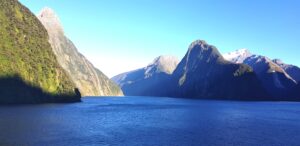
The highlight of the day (arguably of the cruise) was the early morning cruise around Milford Sound, nominated by Rudyard Kipling as his eighth wonder of the world.

The weather was perfect; friends who have been to the Sound experienced rain and fog. Then on to Doubtful Sound and Dusky Sound before sailing for Port Chalmers, the nearest port to Dunedin.

Port Chalmers (Dunedin)

At Port Chalmers I stepped onto foreign soil for the first time since my mid-2019 UK trip. A NZ$35 (return) shuttle bus ran from the dock into Dunedin, conveniently (for me), stopping near the railway station. The station is a spectacular building, unfortunately half-shrouded in scaffolding when we were there.

Then up to the Octagon at the heart of the city, St Paul’s Cathedral, Otago Museum, then back to the Toitu Settlers Museum, before getting the shuttle back to the ship.

Lyttleton (Christchurch)

The overnight sail took us to Lyttleton, the port for Christchurch, 12km away. Another NZ$35 shuttle.

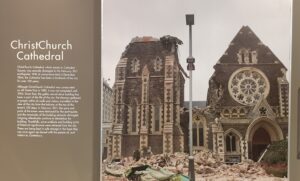
Christchurch has been, sadly, totally reshaped by the 2010 and 2011 earthquakes which killed 185 people and destroyed thousands of buildings, including the iconic cathedral spire.

After walking round the city centre I went on to the Quake Museum where I spent a couple of hours taking in the horror that Christchurch residents lived through (and still do to a degree). Then a walk through the Botanic Gardens and past the Arts Centre buildings to get the shuttle back to the ship.

At Christchurch my one and only credit card stopped being accepted by card readers which left me with a just small amount of cash – I know to be better prepared next time!

Wellington

On to North Island. Our third port day, Sunday Jan 15th, was spent in Wellington, New Zealand’s capital. The shuttle bus was free this time. Yet another beautiful sunny day.

Before it got too hot I climbed to the Mount Victoria lookout (196m) with its stunning views over the city then back down to the Te Papa Museum of New Zealand. The Gallipoli gallery reminded me of the huge sacrifices made by NZ troops in WW1. In total I walked more than 22,500 steps.

Napier

Another, day, another port: Napier. This was the only place where I took a ship tour, and I am glad I did: an hour’s coach tour followed by a visit to the Art Deco Centre then an excellent guided walk around the city centre.

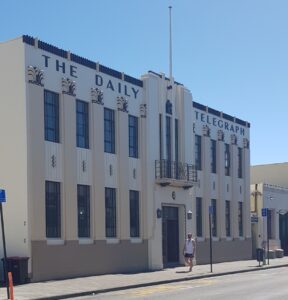
On the morning of 3 February 1931 Napier city centre was destroyed by a massive earthquake and ensuing fires. Within a few years it was largely rebuilt and now has one of the world’s greatest concentrations of Art Deco buildings.

After the walk we were left to explore on our own. The seafront with its beautiful floral displays brought back memories of happy childhood seaside holidays.

Tauranga

Port five, Mount Maunganui/Tauranga, was a bit different: no sightseeing, rather a chance to meet up with friends of 40+ years, who emigrated to NZ in 1996. Tugs pulled us off the quay: large ships aren’t allowed to use bow thrusters as they could damage the quays.

Soon after departure the captain made a somewhat opaque announcement re increasing respiratory infections (carefully not using the ‘C’ word), warned us that the programme might need to be changed, and reiterated that we were required (not requested) to wear masks in public areas except when eating and drinking.

Auckland

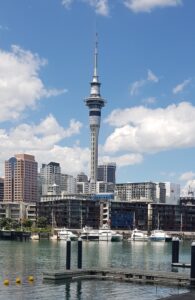
Last stop before sailing home. Just six hours in Auckland, New Zealand’s largest city: we had to sail at 1500 so as to leave the harbour clear for commuter ferries.

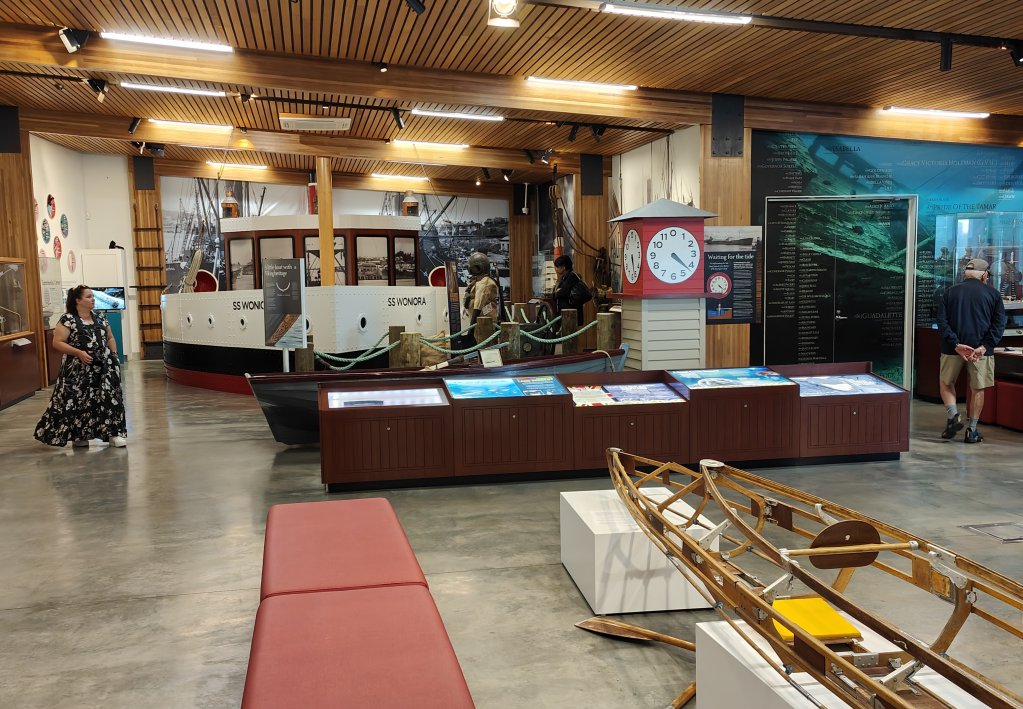
I enjoyed more sunshine walking round the city centre, finishing up at the New Zealand Maritime Museum. Nine days later Auckland experienced unprecedented rain and massive floods.

The unexpected

The voyage back from Auckland to Melbourne took three full sea days. It was a little choppy along the way which upset my system – so sad not to be able to enjoy all the good food on offer.

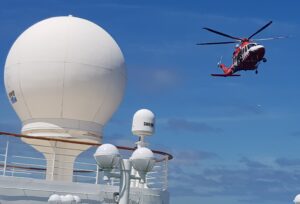
Not on the schedule was a helicopter medivac on the last full day. The helicopter was at the end of its range so after dropping two paramedics had to return to the mainland to refuel, then returning to the ship to collect the paramedics and patient. Hopefully he/she has made a full recovery and had travel insurance.

Life on board

With the veiled Covid warnings I decided to play safe and gave most of the mass entertainment a miss. I did though go to the sea day Bible studies – it’s left to those attending to decide how these are run and the ones on this voyage were not as good as some I’ve engaged in previously.

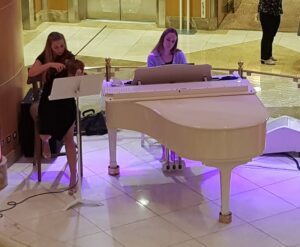
What gave me particular joy was listening to the recitals given by the Amethyst Duo, two young women from Ukraine, Varvara (piano) and Valeriia (violin). For them, a world away from home in more senses than one.

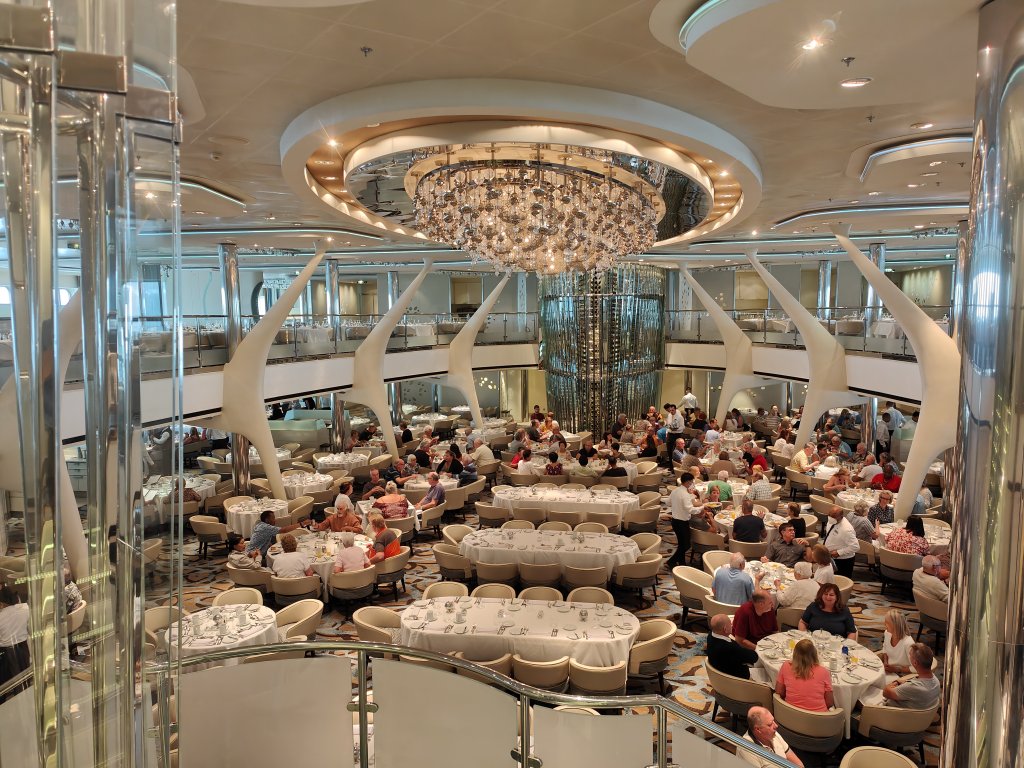
The pre-destination lectures given by tour manager Sue Beard were truly excellent. I had a Club Class cabin so ate in a reserved area of the Da Vinci dining room. My waiters Rommel and Nishi were outstanding. Across the board, the crew members I met could be not be faulted.

In summary, since I was a solo travelled and opted for a mini-suite it wasn’t a cheap cruise, but for me the experience more than justified the cost. But currently two people sharing an interior cabin can do an identical 12-night cruise for just A$1198 (~£700) – cheaper than staying in a cheap hotel and that’s before you factor in meals, entertainment etc.

Now to 2023 cruise number two!

* * *

Cruise map (from Princess Cruises)

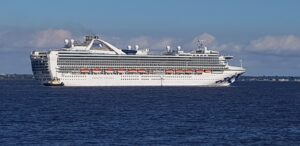
Grand Princess

Grand Princess

Milford Sound

Milford Sound

Milford Sound

Milford Sound

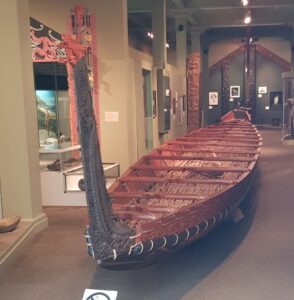
Maori canoe, Toitu Museum, Dunedin

Maori canoe, Toitu Museum, Dunedin

Picture of Christchurch Cathedral after the earthquake

Picture of Christchurch Cathedral after the earthquake

Christchurch Arts Centre

One of the Christchurch Arts Centre buildings

View over Wellington from Mount Victoria

View over Wellington from Mount Victoria

Te Papa Museum, Wellington

Te Papa Museum, Wellington

Art Deco Centre, Napier

Art Deco Centre, Napier

Daily Telegraph building, Napier

Daily Telegraph building, Napier

Making a new friend in Tauranga

Making a new friend in Tauranga

Auckland

Auckland

Auckland Ferry Terminal

Auckland Ferry Terminal, 1912

Medivac helicopter

The sight you don’t want to see

Beautiful music from the Amethyst Duo

Beautiful music from the Amethyst Duo

Melbourne from Station Pier

Home!


Election Reflections – Now What?

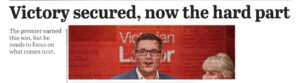
'Victory secured', The Age, 28 Nov 2022

‘Victory secured’, The Age, 28 Nov 2022

So now we look forward to another four years of Labor government. Covid was hugely divisive – Dan Andrews attracting a lot of support for what many saw as his decisive if unpopular leadership in an effort to keep us safe whilst the opposition and the usual media suspects were doing their best to undermine him and the measures he implemented. His strategy has been vindicated. As a regular correspondent put it in a letter to The Age:

Daniel Andrews won because he builds things you can see: roads, railways, hospitals. When COVID-19 arrived he ignored the complaining and did that “making the hard decisions” thing people talk about. He got on my nerves but he got on with the job.  PJ Bear, Mitcham

On the other side – from the Herald Sun and Sky News journos – there was lots of noise. But arguably all they were doing was talking to the converted whilst repelling those they should have been converting to their cause. When yet another letter gets printed in the HS saying “I don’t know anyone who would vote for Dan Andrews“, all the writer is doing is displaying the limited circles in which they move.

As the Age observes, “Victory secured, now the hard part“. We are currently facing major issues arising from Covid, the Ukraine war, a possible slump in the housing market and/or recession. The only certainty is that in four years’ time things will be very different. Although Dan Andrews says that he will serve a full term (which would be unwise IMO: too many politicians fall into the trap of failing to quit whilst they’re ahead) I suspect that he will step down once the metro tunnel opens in 2025, rightly seeing this as his legacy and the culmination of his government’s massive investment in infrastructure.

Should Dan stand down, his likely replacement, Jacinta Allen, would then be up against the Libs newly-elected leader, John Pesutto who, unlike his predecessor, comes across well in the media. In the meantime Labor needs to note the large swings against them in some areas and address well-founded concerns re poor governance. During the election it was reported that the Labor administration employs 250+ special advisors, political appointments. What’s happened to the independent civil servants who gave unbiased advice to ministers, then implementing the agreed policy? If our ministers are open to frank and fearless advice from public servants who have long experience of their subject area we might get better decisions.

Election Reflections – The Media

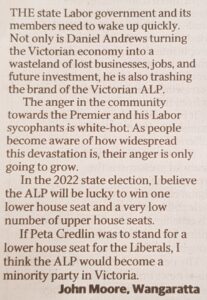
Election prediction, Herald Sun letters, 19 Feb 2021

Election prediction, Herald Sun letters, 19 Feb 2021

Compulsory voting arguably makes for a more democratic result. In the 2018 Victoria state election just over 90% of those on the roll voted (it will never be 100% since people die, move away etc as well as failing to vote), compared with 67.3% in the UK’s 2019 General Election. The downside of compulsory voting is that as everyone has (in theory) to vote, if you can get mud to stick on your opponent you may reap the benefit.

Plenty of mud was thrown in our recent election; thankfully it didn’t stick. Sky News and the Murdoch press carried on a relentless vendetta against Premier Dan Andrews, the Herald Sun reportedly carrying 150+ anti-Dan stories during the campaign. Will they ever learn that such mudslinging achieves nothing? I doubt it.

Back in February 2021, in the middle of Covid lockdowns and other restrictions, Herald Sun reader John Moore of Wangaratta forecast that “in the 2022 state election, I believe that the ALP [Labor] will be lucky to win one lower house seat”. He’d better stick to his day job: in Dan Andrews’ 2018 ‘unrepeatable’ landslide victory, Labor won 55 of the 88 lower house seats. In 2022, 56!

The Daniel Andrews paradox: the enduring appeal of Australia’s most divisive premier (the Guardian)

'Guy closing gap', The Age, 22 Nov 2022

‘Guy closing gap’, The Age, 22 Nov 2022

In the lead up to 2022’s vote the press was claiming that a minority government was a real possibility. Check out this nonsense published by Sky News:

“… a survey by bi-partisan RedBridge Group earlier this week that suggested Mr Andrews will be forced to form a minority government. The analysis had implied that Labor will fall two seats short of the 45 needed to form a majority government on its own. Labor currently holds 55 seats to the Liberals’ 27 – but aside from the opposition it is also under threat from various Greens, teal and regional independent candidates. There is also a suggestion Mr Andrews could lose his seat of Mulgrave, where he is being challenged by independent Ian Cook.

The actual result: Labor increased its lower house representation to 56. As for Mr Cook, he got a respectable 18%, but Dan Andrews’ 51% saw him re-elected on an absolute majority.

Opposition leader Matthew Guy was well and truly humiliated, his concession speech claim that “What we can see is that with a swing of around four per cent to us and many pre-poll votes to come, we will finish … with more seats in the parliament in both the lower house and the upper house,” proving to be untrue. The next day he resigned, having led his party to two disastrous defeats.

What next?

Election Reflections – The Count

The UK’s first past the post (FPTP) voting system has several key problems. It can be ‘dangerous’ to vote for your most favoured candidate you since by doing so you may hand victory to a candidate you really don’t like. For example, in the UK if you vote for a UKIP candidate, your vote might let a Labour candidate win whilst you’d rather be represented by a Conservative. With preference voting, as used to elect Victoria’s lower house, you could vote UKIP:1, Con:2, your vote going to a candidate you can live with, if not the one you prefer. Informed voters understand this and so may change the way they vote (tactical voting), thus the number of votes cast for each party is not necessarily a true reflection of popular opinion. FPTP may mean that a third or less of those voting voted for the successful candidate.

FPTP vote counting is quick and easy. In UK each constituency’s count is done in one place behind locked doors. After a few hours (in most cases) a moment of theatre follows where the Returning Officer and candidates mount the stage to hear “I, John Smith, being the Returning Officer for xxxx do hereby declare that the number of votes cast for each candidate was ….”, speeches from the victor and other candidates following.

Here interim results are released as the count progresses, from which TV pundits predict the result. At some point Antony Green, the ABC’s election guru, will often ‘call’ a seat/the election for a particular candidate/party even though many votes remain uncounted. Unlike UK, postal votes only need to be posted by the close of poll and will be counted if received with six days, so in a few closely contested seats it took more than a week for the result to be finalised.

Election Reflections – Background

Saturday November 26th 2022, 17 days ago, was state election day here in Victoria. Australia’s system of government borrows from the UK and USA as well as being influenced by our own history – we have federal (national) and state governments and local councils. State government responsibilities include schools, hospitals, roads, railways and public transport.

The Victorian parliament, comprising two houses, is elected for fixed four-year terms. The upper house (Legislative Council) consists of 40 members, five each from eight large electoral areas, elected by proportional representation. It’s rare for any one party to have a majority in the Council so to get legislation passed the government of the day must get the agreement of the opposition or a certain number of cross benchers.

The lower house, the Legislative Assembly, consists of 88 members, each representing one constituency. Unlike the UK which uses first past the post voting, members are elected using alternative voting. The ballot paper lists all the candidates and their party affiliations. For the vote to be valid the voter needs to preference all candidates: 1 for the most favoured candidate, 2 for the next and so on. Failure to number all the candidates renders the vote invalid. Virtually everyone on the electoral roll is required to turn up and vote (or be fined) but there’s nothing to stop anyone putting a spoiled paper in the ballot box, alternatively making a ‘donkey vote’ – numbering the candidates 1, 2, 3 … regardless of who they represent.

At the polling stations party workers hand out ‘how to vote’ cards, obviously each one showing their candidate as number one. When I first moved here I was naïve enough to think that the list order was determined by candidate merit but it’s all down to pure self-interest: at this election the Libs (Conservative in UK parlance) were second preferencing the Greens with whom they have next to nothing in common whilst advocating ‘put Labor last’, even behind some very unsavoury right-wing candidates. Pure cynicism.

At count time all the first preferences are counted. If one candidate has more than 50% they are elected, no further counting being necessary. Otherwise the candidate with the lowest number of first preferences is eliminated and the second preferences replace the discarded first preferences. If a recount now produces a candidate with more than 50%, they are elected. If not, the elimination and recount procedure is repeated until a successful candidate emerges. A better system?

Return of the Cruise Ships

Coral Princess approaches Station Pier

Coral Princess approaches Station Pier, 15th Sept 2022

For those of us in Melbourne who love looking at and travelling on cruise ships it’s been a long time since the 2019-2020 season was brought to a premature end by Covid on March 19th 2020. Then nothing for two and a half years until we had a visit from the Coral Princess on September 15th. She was welcomed with fire hoses as media helicopters overhead reported her arrival. But then nothing ….

Carnival Spendor and Pacific Adventure at Station Pier

Carnival Spendor and Pacific Adventure at Station Pier, 1st Nov 2022

… until this week – the first Tuesday in November being Melbourne Cup day – when the cruise ship season proper restarted, the Pacific Adventure, Pacific Encounter and Carnival Splendor bringing in thousands of visitors to watch the big race – just sad for our visitors that the weather was so cold, wet and generally unwelcoming. But that’s Melbourne for you – we’re now forecast to have temperatures in the mid-20s all this coming week.

Grand Princess leaving Melbourne

Grand Princess leaving Melbourne, 4th Nov 2022

Of particular interest to me, last Friday morning (Nov 4th) the Grand Princess arrived from Sydney. She’ll be based here all season, running thirteen cruises from Melbourne, the most important of which is the one I’ll be on in January, my first cruise since 2020. That evening I watched her sail for Port Chalmers, Dunedin, the first post-Covid cruise originating from Melbourne. After circumnavigating New Zealand she’ll be back here on Nov 17th. Cunard’s Queen Elizabeth, which will also be homeported here all season arrives next Sunday Nov 13th. I’ll be there to see her.

Melbourne’s cruise terminal is Station Pier, Port Melbourne. From its opening in 1854 it was linked to Flinders Street Station 3mi/4.5km away, by Australia’s first railway, replaced in 1987 by tram 109. During WW2 huge numbers of troops passed through Station Pier. After WW2 it was the arrival point for emigrants to Victoria: between 1949 and 1966, an average of 61,000 passengers arrived every year, peaking at 110,802 in 1960.

Spirit of Tasmania I and Seabourn Odyssey at Station Pier

Spirit of Tasmania I and Seabourn Odyssey at Station Pier, 22nd Feb 2010

With the development of aviation this trade disappeared and the pier saw fewer and fewer visitors, the main source of traffic being the daily ferries to Tasmania. On 23 October 2022, TT-Line moved its Victorian terminal from Station Pier to a new terminal just outside Geelong, leaving Station Pier as a dedicated cruise ship terminal.

One of my regrets is that cruise ships can’t come up river and dock in Victoria Harbour below my balcony. Why not? Because the 1990s Bolte Bridge was constructed with a clearance of 25m, far too low for today’s cruise ships (the Queen Elizabeth, now classed as a mid-sized ship rises 56.6m above the waterline). But cruising was very much a minority interest then. The Melbourne 2004-05 cruise season (the first for which PoM statistics are recorded) saw just 16 ship visits with 34,839 passengers and crew. Ten years later this had grown to 75 and 242,854 respectively. This season we’ll see more than a hundred ship visits with 120 visits provisionally booked for 2023-4. Hopefully our shortly-to-be-elected new state government will work with all interested parties to ensure that continuing growth is catered for and our visitors enjoy their time here.

Box Hill Cemetery visit

Instead of the usual talk, our October 2022 Box Hill Historical Society meeting took the form of a tour of Box Hill Cemetery (map). After the tour I did a bit of exploring on my own.

Box Hill cemetery first burial

Box Hill cemetery first burial

This story starts in 1872 when twelve acres of reserve to the east of Box Hill was set aside for use as a cemetery. The first burial, of three week old Jessie Lavinia Smith, took place on 30 August 1873.

In 1886 land between the cemetery and the recently extended railway line from Box Hill to Lilydale was annexed as an extension to the cemetery. Then in 1935 a further twelve acres was purchased by the Box Hill Council, bringing the cemetery to its present size of ~12.5 hectares (30.8 acres).

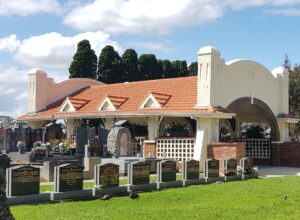
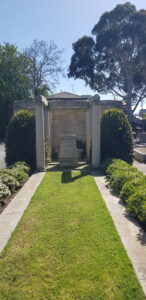
Box Hill cemetery columbarium (1929)

Columbarium (1929)

Box Hill cemetery pavilion (1923)

Pavilion (1923)

Notable structures within the cemetery are the pavilion, built in 1923 to mark the cemetery’s 50th year, and the 1929 columbarium built as a repository for the cremated remains.

In total around 50,000 people are interred at Box Hill. Here are a few of them:

Three businessmen who cared about the less fortunate

Sidney Myer

Grave of Sidney Myer, d.1934

Grave of Sidney Myer, d.1934

The most notable grave is that of Sidney Myer, founder of the department store chain and one of my great heroes. He was born Simcha Baevski in present day Belarus in 1878, coming to Melbourne in 1890. He died suddenly on 5 September 1934, aged just 56.

The Argus summed him up thus: He [Sidney Myer] came to Australia unknown and almost penniless. His life has closed with his name and his deeds known far and wide and with the largest general store in the southern hemisphere as a monument to his business ability.

Business success led Myer to be one of Melbourne’s greatest benefactors and so it’s not too surprising that 100,000 people turned out for his funeral. Through the Myer Foundation his generosity continues to this day.

I am not a politician; I do not seek publicity, nor have I any ulterior motive whatsoever, except my love for Australia and the Australian people.” – Sidney Myer

Why was he buried at Box Hill, rather than an arguably more prestigious place such as Melbourne General Cemetery, particularly since his home was in Toorak? Very possibly because Box Hill could offer such a large site. It’s also the grave site of his widow, Merlyn (1900-1982) and the ashes of his son Kenneth (1921-1992) and wife Yasuko who were killed in a light aircraft crash In Alaska.

William Angliss

Angliss family grave

Angliss family grave

A second prominent entrepreneur and philanthropist is William Angliss (1865-1957). He came to Australia in from England 1884, opened his own butchers shop in Carlton in 1886, then moved into exporting frozen meat. By the early 1930s it was claimed that his was the largest personally controlled meat enterprise in the British Empire.

After selling out to Vesteys in 1934 Angliss pursued other business interests and by 1950 was reputedly the wealthiest man in Australia. From 1912 to 1952, he was a member of the Legislative Council of Victoria, his contribution to public life being recognised by a knighthood in 1939.

Sir William died on 15 June 1957. In his will he left £1 million for the creation of two charitable funds: one in Victoria and one in Queensland, which are administered by the William Angliss Charitable Fund, and he is also commemorated by the William Angliss Institute located in the Melbourne CBD which provides training and vocational education in hospitality and tourism.

Robert Campbell Edwards

Robert Campbell Edwards was born in Ireland in 1862. His father died in a farm accident when he was eight months old. In 1877 his mother decided to follow other family members who had already emigrated to Australia and after a long and trying voyage they arrived in Melbourne in 1878. After working for a tea importer he decided to set up on his own. Over thirty years he built up a large real estate portfolio.

In 1895, perhaps remembering his family’s struggles, and being concerned about the number of homeless boys around Melbourne’s streets, Robert established the Burwood Boys’ Home for destitute boys. The home was founded on the principle that: ‘No truly destitute boy is to be refused admission or turned away.’

When the superintendent of the home objected to the policy of taking in completely desperate cases, Robert replied that this is exactly the sort of boy for which the Burwood Boys Home had been established. From 1972 the home took in girls, operating as the Burwood Children’s Home, closing in 1986 when such institutional care was no longer required. The concern for less fortunate continues under the Campbell Edwards Trust.

Now to the graves of two younger women.

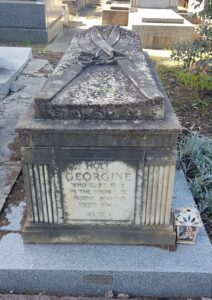
Georgine Gadsden

Georgine Gadsden (1920-1943)

Georgine Gadsden (1920-1943)

Georgine Gadsden (1920-43) was the granddaughter of Jabez Gadsden, founder of the packaging company J.Gadsden Pty Ltd. Her father, Norman Gadsden, served with the Australian Flying Corps in WW1 before rejoining the family business. Her mother, Dorothy, was an operatic singer.

Aged just 23, Georgine met a tragic death on Mt Bogong, Victoria’s highest mountain (6,516 ft/1,986m). The Australian Alpine Club website tells her story,  summarised here:

On August 2 1943, a party of three skiers (Georgine Gadsden, John McRae and Edward Welch) departed Bivouac Hut on the Staircase Spur (4,900ft/1,493m) bound for Summit Hut (6,410ft/ 1,954m) where they planned to spend the night, with the Cleve Cole Memorial Hut being their ultimate destination. Between them they carried sufficient food to last about five days Snow was falling but the party did not consider conditions unduly severe.

On August 5 it was still snowing but with a moderating wind a second group set off for the Summit Hut. Five hours after leaving the Bivouac Hut, they came across the three frozen bodies of the members of the first party lying in the snow, just 80 metres from the almost completely buried Summit Hut. Edward Welch was lying face down. About two metres further up the slope was John McRae’s body. Georgine Gadsden’s body was a further two metres up the slope.

The Gadsden Memorial marks the site of the tragedy.

Once you know this sad story you understand why Georgine’s grave, now ageing, is topped with two crossed skis.

Nellie Catherine Wales, d.1948

Nellie Catherine Wales, d.1948

Nellie Catherine Wales

And now for a mystery. This striking memorial commemorates Nellie Catherine Wales who died in 1948 aged 49. The rain-washed marble waterfall hides its 70+ years well.

The mystery: my Google and Trove searches didn’t produce any information about her, not even a death or funeral notice. Is there, as with Georgine Gadsden’s grave, a story to be told? All I have been able to find out is that Nellie was the daughter of Alexander Wright Wales (1859-1939) who from humble beginnings became a prosperous quarry owner and local politician. Later on, family money endowed  Alexander Wright Wales scholarships at Scotch College. Nellie’s brother George (1885-1962) was Lord Mayor of Melbourne 1934-37.

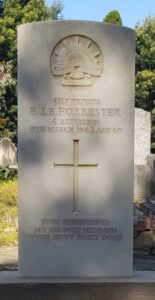
E.J.B.Forrester and 66 others

E.J.B.Forrester war grave, 1942

E.J.B.Forrester war grave, 1942

And, lastly, war graves: within the cemetery there are 67 war graves. The headstone shown here is similar to those used in many Commonwealth war cemeteries.


If you’re interested in joining a future cemetery tour check out the Box Hill Historical Society web site

The Book(let) I wish I’d written

Two months ago I wrote about my eight years working as a Building Control Officer (Building Inspector) in what had been the Malden and Coombe Borough Council area in S.W.London. Over that time I really got to know the area and its history. It was always fascinating to look at the archived plans and peruse old maps – many of the old hand-tinted plans drawn on linen were real works of art. It wasn’t really part of our jobs but we regularly got phone calls from estate agents asking when a property they were to sell had been built, our pre-computer era card index quickly providing the answer. If I’d thought about it, I could have spent my lunch hours compiling ‘Malden and Coombe, Street by Street’, giving a potted history of each street. Too late now! But since I left RBK in 1984 lots of other information has become available. Here’s some:

New Malden’s early development owed much to the railway: New Malden station opened in 1846, with the remaining section of the Kingston loop line from New Malden to Kingston following in 1869. Then just before WW2 the Chessington branch opened, with Malden Manor station serving the new estates south of the A3 Kingston bypass (opened 1927). Although outside the municipality, Motspur Park (1925) and Worcester Park (1859) stations also serve the SE area.

Semi-Detached London New Malden was transformed by inter-war suburbanisation as described in Alan Jackson’s excellent book ‘Semi-Detached London’. Although published in 1973, copies are readily obtainable through AbeBooks. The Medical Officer of Health’s reports available on the Wellcome Library website show the M&C population growing from 7,199 in 1903 to 15,366 in 1923 to 39,930 in 1939. 

Various developers were at work in the area during this period including R.Lancaster, New Ideal Homesteads, Lavender and Farrell, E & L Berg, Crouch and Gleesons, but the biggest of them all was Wates, whose built their distinctive chalets and more conventional Tudor-style semis by the hundred – check out their Wilverley Park estate brochure here.

Whilst preparing this page I found a vast collection of OS maps digitised by the National Library of Scotland. Check out these extracts from the 1911 and 1933 OS maps, the latter showing part of the Wilverley Park estate. The kink in Malden Road provides a reference point. In the 1933 map you also see the A3 clipping the top corner.

New Malden OS extracts 1911 and 1933

New Malden OS extracts 1911 and 1933 reproduced with the permission of the National Library of Scotland

What’s interesting to me is that I’m now seeing this story being replayed to the north of Melbourne, with consent being given for fields to be turned into new housing states at a rate that is hard to believe.

More resources on Malden history:

Maldens and Coombe Heritage Society web site

Village Voice and Worcester Park Life – each issue contains a very good history feature

Alan Godfrey maps: Sy0713: Coombe and Norbiton 1911; Sy1301: New Malden 1911 – hopefully at some point they’ll publish Sy1305 and Sy1306 to cover a lot more of New Malden.

Portland mini-break

Map of SW Victoria

Map of SW Victoria

With nothing on my travel calendar until next year’s cruises, it was time for another mini break. This time I headed west to Portland, on the coast 350km from Melbourne.

What is now Portland was for thousands of years the home of the Gunditjmara people, then from around 1800 it became a whaling port. In 1834, the year before Melbourne was founded, the Hentys, a sheep-farming family originally from Sussex, moved across from Tasmania and Portland became the first European settlement in Victoria. By 1845 their holdings extended over 70,000 acres.

Portland Harbour

Portland Harbour (note B-double truck unloading in the background). The heaps of what looks like sand are woodchips

Through the nineteenth century the township grew, helped by the arrival of the railway in 1877. The now freight-only line (the last passenger train to Portland ran in 1981) was converted from broad gauge to standard gauge in 1995. Harbour trade was limited until the construction of a massive new breakwater during the 1950s. In 1952 when construction began, 21 vessels called at Portland to transfer 45,000 tonnes of petroleum products and 6,513 tonnes of food. By 1960 trade had reached 200,000 tonnes.

Today trade has grown to 7.6 million tonnes per year primarily comprising woodchips which are exported to China and Japan. They arrive on a seemingly non-stop procession of B-double trucks. It takes around 1,000 truckloads of chips to fill a ship. The trucks are driven on to ramps which then tilt them to about 45 degrees, the chips then falling out under gravity – watching the trucks unloading engaged me for a good while, as did watching a ship laden with wind turbine parts being brought into the harbour assisted by the harbour tugs.

Portland cable tram

Portland cable tram

But there’s more to Portland than the port. The town is home to dozens of well-preserved 19C buildings. One key attraction is the Portland Cable Tram, opened in 2002 – it’s not actually a cable tram; propulsion is by means of a diesel engine. The two grip cars are replicas of ones that ran in Melbourne until 1940. The two saloon cars in service began life in Melbourne in 1886.

The tram runs from the depot which houses an interesting museum, past the Botanic Gardens and port, along the foreshore past the Maritime Discovery Centre on to the 25 metre-high water tower which also serves as a lookout and museum to World War II. It then reverses to return to the depot. Amazingly, given that Portland is a town of only 10,000 people, the tram is operated seven days a week by a team of 60 volunteers.

Portland Powerhouse Motor Museum

Portland Powerhouse Motor Museum

Also run by volunteers and open every day is the Powerhouse Motor  and Car Museum. I’ve been to many classic car museums but the interest never wanes. Lots to see: the cars themselves, vintage signs, a collection of stationary farm engines, a diesel tractor, penny farthings, pedal cars, old tools, model cars and much else. My visit fortuitously coincided with a short but heavy storm.

History House (the 1863 Town Hall)

History House (the 1863 Town Hall)

I’ve already mentioned the Maritime Museum which also houses the visitor centre. History House (the original town hall) tells the story of the area and is but one of several dozen mid-Victorian stone buildings.

I stayed at the much more recent Comfort Inn which did me well, dining each night at the 1856 Mac’s Hotel which I can thoroughly recommend for reasonably price bistro-style meals.

All in all a good if short break.

More about the port
Map from Freeworldmap.net


How I became a Building Inspector and why I left

Note: many of the UK public still refer to a ‘building inspector’ though since the 1970s their formal title has been ‘building control officer’.

After leaving university I joined Royal Borough of Kingston upon Thames (RBK) as a maintenance surveyor. Initially I joined a team responsible for school building maintenance, then moved on to maintenance of social services buildings. I worked alongside some great people who nearly fifty years on I still fondly remember. But our overall boss was quite the worst person I have ever worked under. Being torn to shreds (usually with no justification) in front of your workmates was a regular occurrence. And yet – Stockholm syndrome at work? – when he called me in and told me that to broaden my experience I was to be seconded to Building Control for three months I was apprehensive about moving into the unknown.

How wrong I was! The atmosphere was so different. After my first day over dinner – I was still living with my parents – my mum observed: “I’ve never heard you talk about work with such enthusiasm; I think you’ll end up staying there”. How right she was! At the end of my secondment my temporary boss, Ken Beer, Borough Planning Officer, offered me a permanent position, along with a salary increment. I said that I would be more than happy to take the job with no increment but he insisted. When I told my old boss about the offer he exploded with rage, accusing me of ingratitude, underhand behaviour, disloyalty and the rest, adding that he would be going to see the Borough Engineer (my ultimate boss) to have my move stopped.

Back from his meeting he called me in and told me that despite his efforts my transfer could not be prevented: to his chagrin there was apparently a provision in the ‘Purple Book’ (local authority employment terms and conditions) that stated that your existing manager could block an intra-LA transfer BUT only if it didn’t involve a salary increase. That was why Ken Beer had insisted on me having the increment.

With my month’s notice served I went back to Building Control where I was to stay for eight years. RBK had been formed in 1965 as a merger of three local councils: Kingston, Surbiton and Malden and Coombe (M&C). Building Control might now occupy one office, but worked as three largely autonomous teams, as if amalgamation had never happened. Each had a District BCO, Assistant BCO and a trainee. Overseeing these was Peter Fuller, Principal Building Control Officer, who exercised a benevolent oversight over the office, largely leaving each District BCO to run their section as they thought fit. I started as M&C assistant, moving up to District BCO a year or two later. Each of us three had a very different approach: Paul went by the book, insisting on plans being correct in every detail; Peter, older than us, relied on his ability to get things right on site (which he invariably managed) and my approach was somewhere in between.

Several happy years passed during which I decided that I could see myself being M&C District BCO for the rest of my working life. I got to know my patch intimately and took a great interest in its history. Then the time came for Peter Fuller to retire. His replacement had a very different, hands on, approach to management. Before too long he said that things could not continue as before, observing (with some justification) that when someone submitted a plan, they were submitting it to RBK and for the response to be quite different depending on where within the borough the site was, was unacceptable. He produced a document setting out exactly how we were to do our jobs.

Us three District BCOs were self starters, each used to running our own shows, and under this new regime the job satisfaction disappeared. Within a relatively short period we all left. In my case it was to embark on nearly forty years of self employment. I joined RBK with the expectation that I’d spend my working life in public service. Instead, my ten years there were just the warm-up act!