In 1840, five years after the first European settlers arrived in what is now Melbourne, the Moonee Ponds Farmers’ Society was formed, subsequently becoming the National Agricultural Society of Victoria then, in 1890, the Royal Agricultural Society of Victoria (RASV). The NASV’s first show was held in 1871 at their new St Kilda Road showground. In 1882 in exchange for this site the state government granted the Society a 30-acre site in Ascot Vale, 6km NW of Melbourne CBD, where in 1883 the new showgrounds hosted their first show.
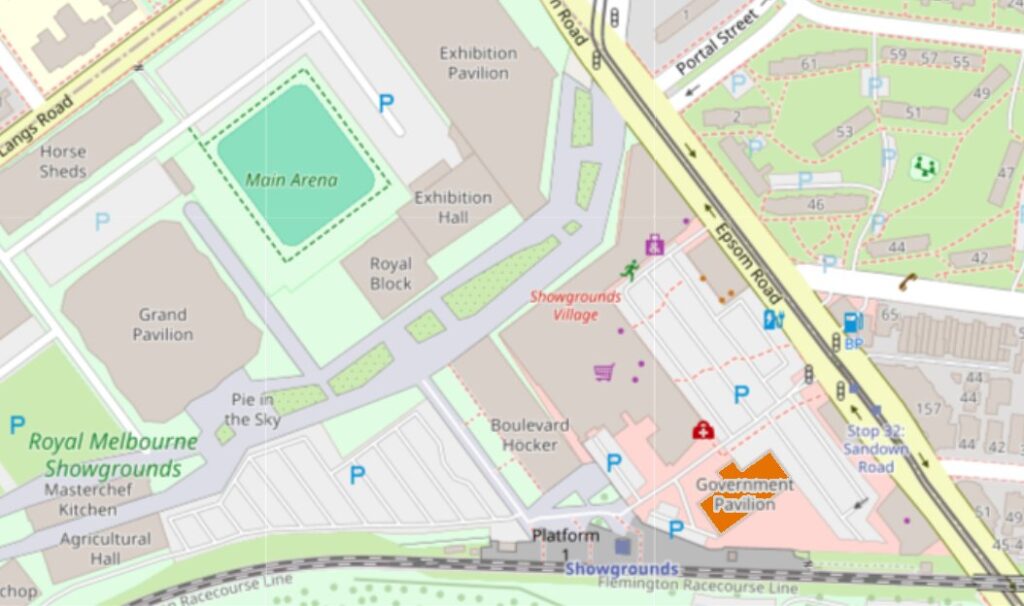
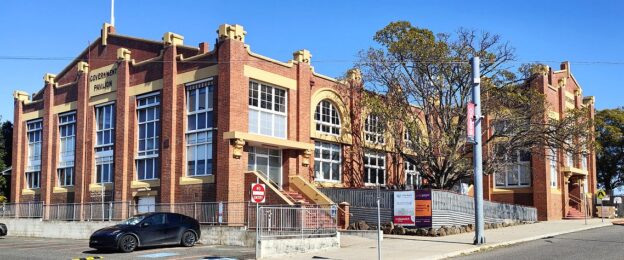
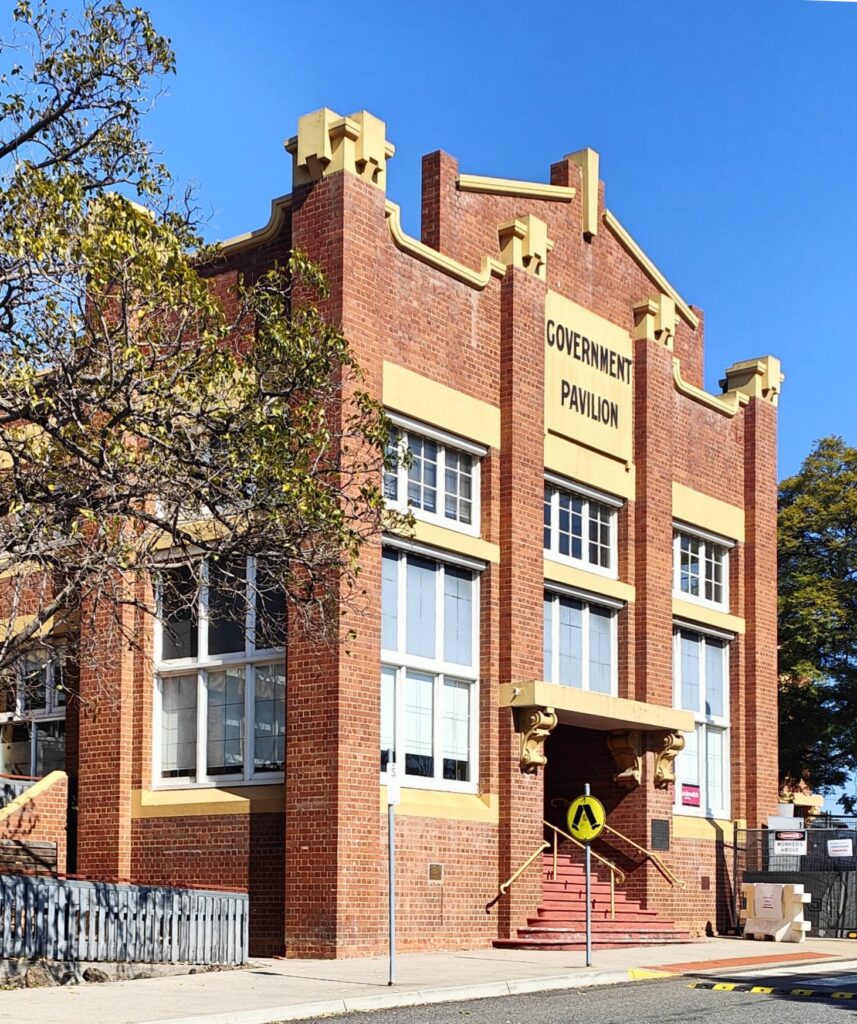
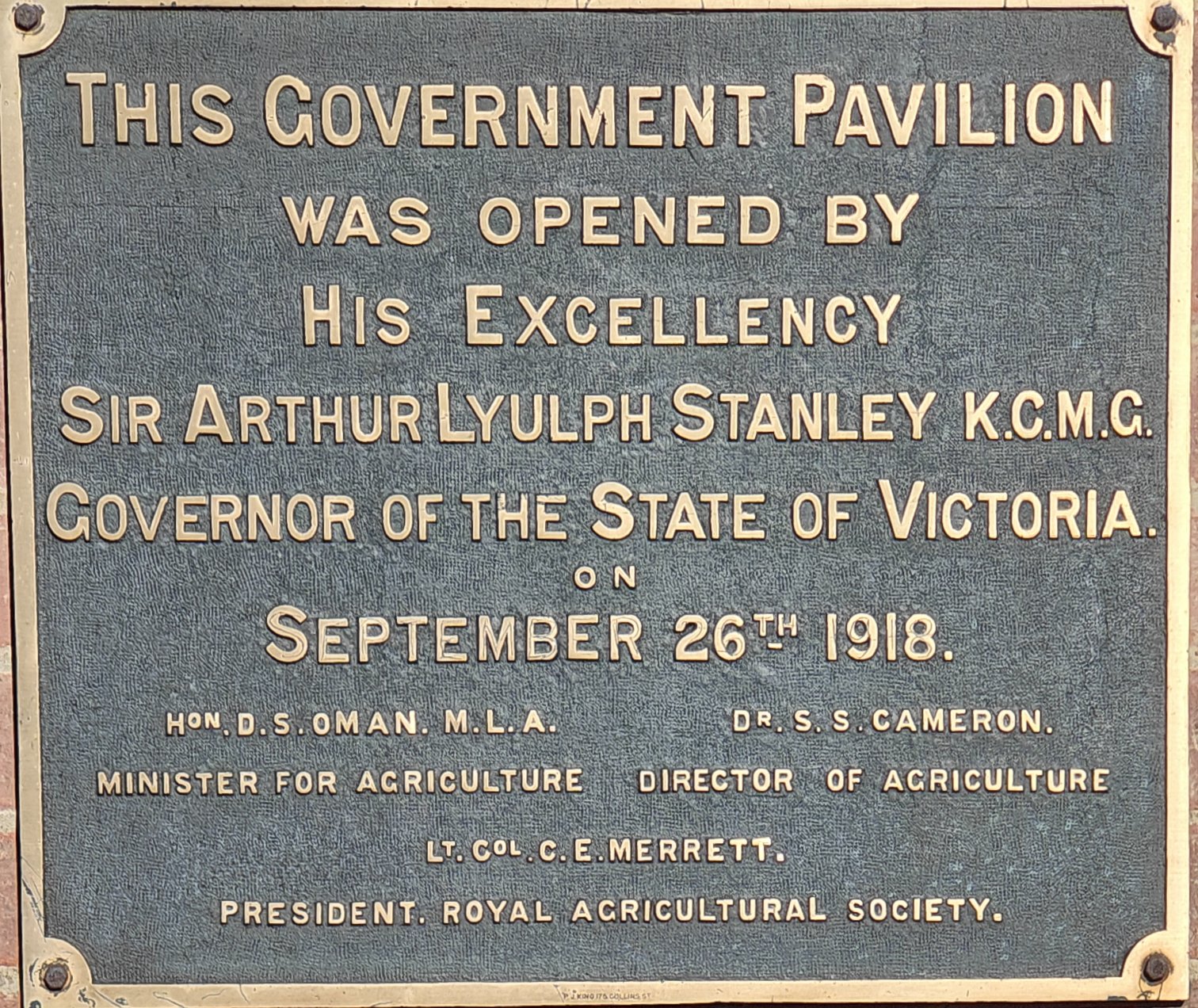
During WW1 the Showgrounds were requisitioned by the government for use as a training camp and military hospital and the facilities were significantly improved. At the November 1917 meeting of the RASV Council a plans for a new Department of Agriculture building on the showgrounds were approved. Initially known as the ‘Government Pavilion’, it was later renamed as the ‘Woodfull Pavilion’ after H. T. Colin Woodfull, RASV Secretary 1953-1973. Design was by Billing, Peck and Kempter, architects who handled much of the planning and design of the showground site in its early years.
Let’s dip into ‘Trove’, the online Australian newspaper archive. Here is some of the coverage of the pavilion’s first years:
Herald, Saturday 10 August 1918, page 7
PREPARING FOR THE SHOW
WOOL TO BE A FEATURE
Preparatory work in connection with the Royal Show next month Is now being carried out by a large number of workmen … The chief work in building has been the erection of the new Government pavilion at the city end of the grounds [contractor Gay and Pickering]. This pavilion, when completed, will have cost nearly £8000. … Its length is 200ft., and its width 80ft. In It agricultural exhibits will be displayed to advantage. … A special feature is to be made of wool, which will be seen in the various stages of treatment and manufacture, from the time it leaves the back of the sheep until it is converted into cloth. The appraisement of wool is not so well understood as it ought to be, by many of the small growers at least, and the State Wool Committee is making arrangements for a special exhibition which will enlighten them as to the various methods adopted for the valuation of the wool forwarded to the appraising centres.
Herald, Tuesday 17 September 1918, page 11
SHOWGROUND IMPROVEMENTS INVOLVE OUTLAY OF £14,000
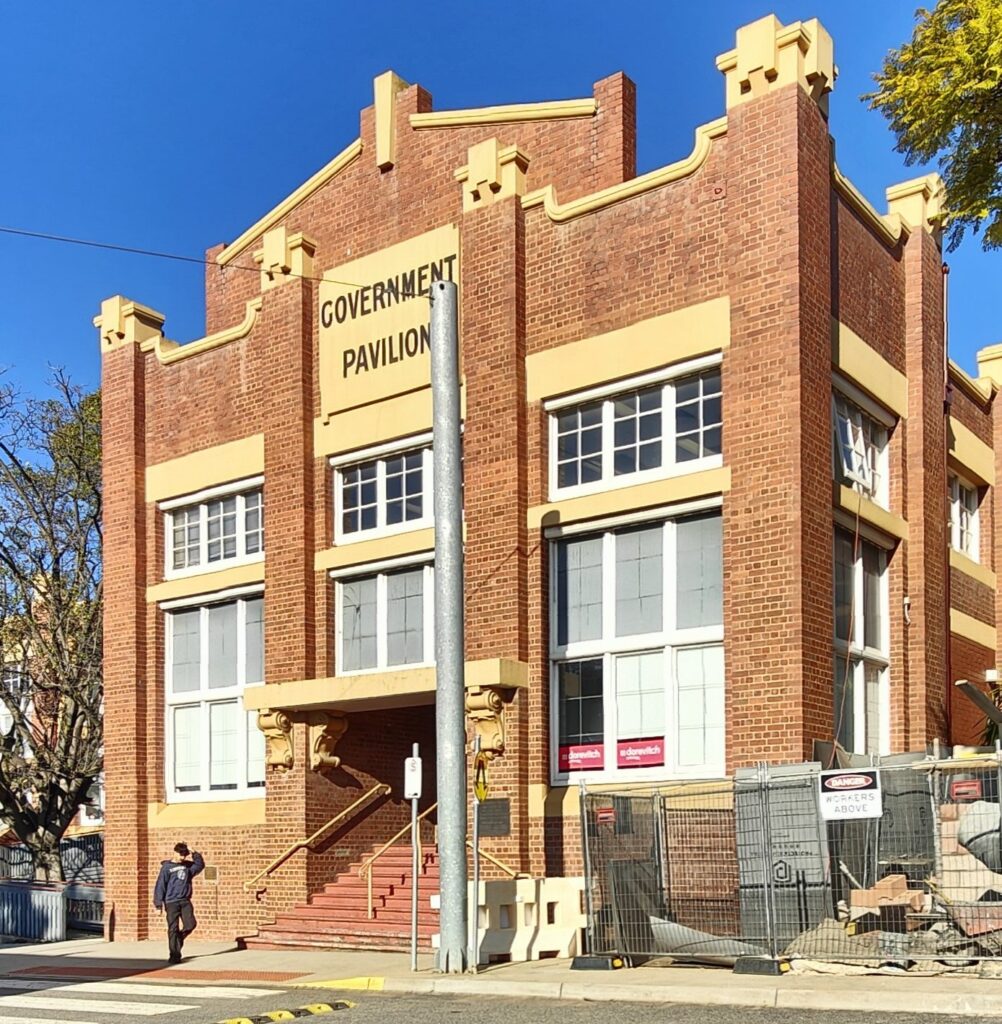
… Perhaps the most striking building In the show grounds is now the new Government Pavilion in which the Government will make its display of the primary and staple products of the State. … On its walls, in large letters, are the words, “Uplift Farm Life,” “Advance Agriculture.” and “Encourage Rural Production.” … Generally speaking, the show promises to prove a striking illustration of the prosperity of the country, and the faith of the people in its resources in the future.
The Melbourne Leader’s reporter came away less than impressed by the 1918 show:
Leader, Saturday 5 October 1918, page 7
THE 1918 ROYAL SHOW.
“The best show ever held under the auspices of the Royal Agricultural Society of Victoria” sums up last week’s big event at Flemington. Nevertheless, the success of this exhibition was marred by many petty irritations that should not be experienced in a well organised show.
The catalogue, which has grown into a fearsome volume of appalling weight, was not the least of the week’s irritations. No individual visitor is interested in every entry, and the admirable practice at the big Easter show in Sydney, where sectional catalogues are issued, should be adopted by the Victorian society. …
The weaknesses of the judging system have been dealt with in past issues of “The Leader,” but the inundation of sale stock, which stamped some of the sections, notably amongst the Berkshire pigs and Ayrshire cattle, must be condemned as an evil that demands very careful attention on the part of the council of the society. The practice has grown into an intolerable nuisance.
The fat cattle section is another feature that is open to improvement. These important classes would be of greater educational value to stock breeders if the society’s schedule directed exhibitors to record the breeding, or cross breeding details, and stipulated that the dead weight of beef (which could be recorded at the abattoirs after the show) be a factor in the allotment of prizes. It is of little use fattening beasts to win prizes if the process represents a practice that would be unprofitable to a grazier….
And then our illustrious correspondent cheers up …
The new pavilion erected by the Department of Agriculture was the newest and one of the most attractive features of the show. It was so roomy and well lighted, and the exhibits were so well arranged, that the change from the cramped and congested state of last year’s display marked one of the most satisfactory improvements of the past week’s show.
… but his joy doesn’t last
We would suggest that a small room be prepared as an addition to the Government pavilion for next year’s show, and that the officers of the department be engaged to deliver addresses at fixed intervals, the time and subject to be duly advertised. There are many visitors who would welcome the opportunity to attend practical addresses in the Government pavilion, but last week’s practice of addressing such men, women and children as choose to stand and listen was futile. Officers, more or less embarrassed, were elevated into a portable pulpit, from which they delivered addresses to moving crowds. It is a wonder that someone did not attach a motor to the pulpit and so permit well-meaning but ignored orators to chase their audiences.
However, the departmental exhibits formed one of the successes of a successful show, and the council, of the society is to be congratulated upon a well-merited reward in the form of fine weather and record attendances.
And then to the 1919 show
Age, Tuesday 23 September 1919, page 8
AT THE SHOW.: A WALK ROUND THE GROUNDS
For a full account of the Age reporter’s visit to the 1919 show, especially his appreciation of the livestock exhibits, check out Trove:
Born pessimists would do well to avoid the Royal agricultural show at Flemington, lest they find themselves converts to optimism. …
… Apart from the animals, however, the city dweller gazes with admiration and even awe at the magnificent exhibits of agricultural produce in the various pavilions, particularly the Government pavilion. “National solvency depends upon increased production,” says a motto here, and the possibilities of production are all around, sufficiently attractive to make the mouth water. There are pyramids of perfect fruit, the gold of oranges mingling with the red. yellow and green of apples and pears, and the canary yellow of lemons. There are tins of jam. But the house holder will linger over the crystal-clear jars of bottled fruits and vegetables— currants, cauliflowers and carrots, purple raspberries of wonderful size, crimson cherries and golden quinces, peaches and plums— a luscious array. One is tempted to ask where the ordinary suburban shopper can buy such fruit as this, but it is some comfort, at all events, to know that it can be produced.
In this pavilion are also snowy fleeces of wool, with a sheen upon them like that of spun silk, and stacks of Australian wines, in bottles of all hues, ranging from amber to deep red. … and above all, a background, as it were, to all the rest, there are the golden wheat sheaves, heavy with grain, from the many acres of wheat land that are so great a source of wealth to the Commonwealth. The eye ranges from the translucent amber cylinders of honey to the hundreds of white and brown eggs packed daintily on light green shavings from plump turkeys and sides of beef to slabs of yellow butter; from Turkish Delight and other sweetmeats made from beet sugar to heaps of vegetables mid snowy piles of dried milk powder.
… For the rest, the farmer and the city dweller may rest their eyes upon anything from jewellery, pianos, fine furniture, to a joy-wheel and a skittle alley; while in the ring yesterday were crowds watching the various animals being put through their paces before calm and omniscient judges. And finally, the brilliantly varnished buggies and glossy motor bodies may serve as a hint of the fact that even the primary producer has his luxuries. …
No shows were held during World War II as the Showgrounds had been requisitioned for RAAF use. In 1946, the first post-war show held saw a new record attendance of 652,666. In 1972 the Show was extended to ten days and ten nights, hitting another record attendance, 916,730 visitors (Victoria population then approx. 3.5m). More recent shows have drawn around 400,000 visiors
Over time the site grew to 67-acre (27ha) but by the early 2000s the facilities were very run down. In 2005 approximately 11 acres (4.5ha) of non-core land next to Epsom Road was sold off for redevelopment. Now the Showgrounds Village shopping centre, it incorporates a Coles supermarket, shops and bottle shop. The heritage-listed Woodfull Pavilion was included with the land being sold. It was repurposed as offices, a child-care centre and my cardiologist’s suite of rooms, reverting to its original name.
Trivia: The interior scenes in the 1959 film ‘On The Beach’ were shot in the Government Pavilion)
Map from OpenStreetMap
Speed the Plough: A History of the Royal Agricultural Society of Victoria, Volume One (1840-1980)