Category Archives: Autobiography

My motoring life

This post lists the cars I’ve owned over the last fifty-four years. Sadly, I don’t have pictures of most of them. On turning seventeen I got my provisional licence and signed up with the instructor who had taught my mother to drive. In May 1971, at my second attempt, I passed the test and getting a car became my all-consuming ambition. I was working for the AA between school and university and reckoned I could save £100 for the car + £50 for insurance. My father didn’t drive, couldn’t see why I needed a car and so was not willing to help me, a pity really as an extra £100-£200 would have made a huge difference to what I could buy.

Now for the cars

1. 1962 Mini

After endless scanning of ads in the local paper and Exchange and Mart and numerous wasted visits to view rust boxes I settled on a nine-year old Mini that showed its age. I should have waited until I’d saved a bit more but the impatience of youth knew no bounds. The car may have cost £100 but during the two years I owned it I spent around £400 on replacing parts, most expensively the engine and gearbox, but also was a sucker for accessories that would allegedly make the car go better, faster or be safer. Most Saturdays were spent fixing something, whether necessary or not.  Its fate was sealed when a massive Scania truck ploughed into it when stopped at traffic lights.
Engine: 848cc, 34 BHP, Overall length 3.0m


2. 1970 Mini van

The cars that followed were much better, largely because by then I had more money at my disposal: the Mini was replaced by 1970 Mini van bought from my upstairs neighbour. It had the optional 998cc engine. I fitted, necessitating the payment of Purchase Tax. This vehicle served me well for several years.
Engine: 998cc, 38 BHP, Overall length 3.3m


3. DAF 66 Estate

In 1976 I got promoted to District Building Control Officer, one benefit of this being that I now qualified for a low-interest car loan, repaid by deductions from my salary. DAFs of this era were famous for their own ‘rubber band’ automatic transmission, since reinvented as CVT transmission used in millions of cars across the world. It made for a very good car when driving from site to site. Helpfully, the nearest main dealer to me, Woodlawn Motors was easy to get to.
Engine: 1289cc, 57 BHP, Overall length 3.8m

4. 1979 Chrysler Sunbeam 1.3 – my first new car

I can’t remember why I decided to change cars, but the Chrysler Sunbeam caught my attention. I was particularly attracted by the frameless rear window.After a while I decided that I needed something with larger luggage capacity. Going over the jaded paintwork with T-Cut left patches of primer. The solution was what is known as a ‘blow over’. The trade-in dealer was not impressed!

Engine: 1295cc, 59 BHP, Overall length 3.8m


5. 1981 Austin Maxi 1750L

About this time  British Leyland were selling off stocks of the just-discontinued Austin Maxi. A new one could be mine for £4,100 and soon was. To my boss’s chagrin, mine, unlike his, was a good reliable vehicle. Apart from the load-carrying capacity, the other attractions were the 1748cc engine which brought in a higher work mileage allowance, and its overall length of 4.04m, which meant just it fitted in the off-street parking space at my home. It stayed on the DVLA register until 2000, a life of 19  years.

Engine: 1748cc, 72 BHP, Overall length 4.1m


6.1985 Austin Maestro HLE

Maestro cutaway (from brochure)

Maestro cutaway (from brochure)


Lot of people rate the Maestro as British Leyland’s worst car. I beg to differ: I like the big doors, generous glass area and wheel-at-each-corner styling. A local dealer had this one on the forecourt and with the benefit of finance (which I later regretted) it was mine. It was an HLE model (premium trim, economy tune) and was a beautifully relaxing car to drive.

AROnline Maestro development story.Engine: 1275cc, 64 BHP, Overall length 4.05m


7. 1990 Skoda Favorit

8. 1995 Skoda Felicia

In the early-1990s my business was failing and I was deep in debt. Then the tide turned. With more than a little difficulty I cleared the car loan on the Maestro and sold it, giving me a temporary cash buffer. My DAF dealer (above) now sold Skodas  and I was able to buy a Favorit 136L on HP with a very low deposit, the remaining cash tiding me over – this was the time of the velvet revolution in Czechoslovakia so perhaps Skoda were desperate to move metal.  When I collected it, I looked at the dashboard and remarked to the dealer, “it’s got a rev counter; this model doesn’t”. In reply he said “it’s so chaotic in the factory that they’re fitting whatever they can find: count yourself lucky”.  

Following Volkswagen’s takeover of Skoda, The Felicia was a reskinned Favorit with other VW engineering improvements – for example mine retained the Skoda 1289cc engine, but with fuel injection rather than a carburettor.

Engines: 1289cc, 63/68 BHP, Overall length 3.85m

/

9. 1998 Suzuki Wagon

Suzuki Wagon series 1 (from brochure)

Suzuki Wagon series 1 (from brochure)

As someone who places a premium on functionality, the Suzuki Wagon looked just the vehicle for me. Others were less keen. Jeremy Clarkson (IIRC) said of it “the only person who would buy one of these is an escapee from a lunatic asylum”. And I was hoping to keep my secret safe! Uniquely both Wagons were built in Hungary.

10. 2001 Suzuki Wagon

Suzuki Wagon series 2 (from brochure)

Suzuki Wagon series 2 (from brochure)


The  second incarnation of the Wagon was an aesthetically less challenging restyle. Mine is still on the DVLA register, MOT expiring January 2006. Apart from my DAF it was my first automatic.

Engines: 996/1298cc, 64/75 BHP, Overall length 3.4/3.5m


11. 2003 Honda Jazz

12. 2006 Honda Jazz

My second Honda Jazz

My second Honda Jazz

When the Honda Jazz appeared I knew it was the car for me, mainly because of its ‘magic seat’ which when folded gave a massive luggage capacity. I bought one and wasn’t disappointed.

Three  years on I got a mailout from Chiswick Honda saying that they were short of cars like mine and would be able to offer me a very good trade-in price against a new Jazz. My first instinct was to ignore it, but on checking their website this looked to be true. At Chiswick Honda I tabled a printout of an ad showing what they could sell mine for, and my cheque book (remember them?) and said that if they could agree to £4,000 cost-to-change we had a deal. They did, we did.
Engines: 1339cc, 82 BHP, Overall length 3.3m


Why these cars?

When I moved into my own home in 1981 the 4m max parking space (ex front garden) was a key factor in choosing a car.

Whilst working as  a council employee  (1974-1984), maximising the difference between the mileage money one could claim and running costs was a key factor: thus a Maxi 1750 could be a better option than something smaller.

Once I became self-employed in the UK (1984-2008) it made most sense to run my cars as company cars and change them every three years or so. Choosing cars like my two Suzuki Wagons and two Honda Jazzes kept the perk tax to a minimum. IIRC the tax due was originally based on engine size, then on CO2 emissions. The Jazz was particularly good in this respect.

The ones I didn’t buy

You’ll have noted the absence of exotica, fast cars and prestige cars. No Fords or Vauxhalls either.

For my first car, I was mainly looking at Minis. I would have done better with an Austin A40 or Morris 1000, but the techno-snob in me didn’t want a car with 1950s technology. I also looked at several Wolseley Hornets and Riley Elfs (Minis with a boot) but the ones in my price range were really ready for the breakers.

Later I was attracted by the idea of a Saab 96 or Nissan Prairie  but both were too long for my parking space. With hindsight I wish I’d bought a Triumph 1300 at some point.

And in Australia …

Here in Australia I’ve owned a Prius C, Nissan X-Trail and  Toyota RAV4 hybrid.


In my teenage days most of my contemporaries and me impatiently waited for our seventeenth birthdays, the point at which we could apply for provisional driving licences and start the journey that would end with passing the driving test.  This is now less the case: In UK a government report stated that  driving licensing among young people peaked in 1992/4, with 48% of 17-20 year-olds holding a driving licence. By 2014 only  29% of 17-20 year olds held a licence.


On reaching seventy

At the start of July I reached the Biblical threescore years and ten: Our days may come to seventy years, or eighty, if our strength endures; yet the best of them are but trouble and sorrow, for they quickly pass, and we fly away (Ps.90.10 NIV). Thankfully most people live beyond eighty but living a long life is a mixed blessing if our last years are marked by physical or mental impairment.

I kicked off my birthday dinner with a short speech reflecting on fifty years of adult life:

  • In my 20s I was a council building inspector and originally expected to be there until I retired. My holiday ambitions went no further than Southend-on-Sea, 40 miles (64 km) east of central London.
  • In my 30s one throwaway comment from a friend’s wife set me on the path of 37 years of self-employment. Another throwaway comment from another friend led to me making my first overseas trip as an adult. Since then I’ve made around 30 UK-USA trips, 15 trips to Australia as a British tourist and a similar number as an Australian visiting the UK, four trips to Africa and some other places too, and, in recent years, multiple cruises.
  • My early years of self-employment did not go well: the low point was reached around my 40th birthday when I was deep in debt and my bank threatened (metaphorically) ‘to send the boys round’. Yet another throwaway comment from yet another friend to me back to uni to study Business Studies and this was a key driver to my business coming good.
  • Five years later I was back in Melbourne enjoying the Christmas sunshine when the notion came to me, ‘you’re so happy here: you should move here’. Finally in 2008 I was able to do so – the best decision I’ve ever made.

Regrets – here’s just a few

If I could re-live my adult life knowing what I know now, what would I change?

Study: I took my first degree with University of Reading, the first year being based at the College of Estate Management in Kensington, then in the new FURS building at Reading Whiteknights. I commuted from home and the experience was an extension of school. Being then very introverted, going to a university that would have required me to live away from home would have been very challenging, but I see now that it would have been good for me.

Home: After leaving university I began to think about having a home of my own. At that time (mid 1970s) the general rule was that you could borrow three times your salary plus, where applicable, one times your fiancée’s/wife’s salary. As I was single this left me able to borrow around £6,000, not enough for the average house. My interest was taken by a house in Warwick Road, Twickenham, a rundown two-up, two-down terraced cottage. This didn’t worry me since I would have enjoyed renovating it but given its condition at that time the only mortgage available was from the council at 17½% interest! My dad’s opinion was ‘you’d be daft to spend £7,000 on a house like that’ and I followed his advice. A year later my salary had all but doubled and interest rates had fallen, so the pain would have been short-lived. Houses in Warwick Road now sell for £600K and more!

Exercise: In the UK once I became self-employed I ran my car as a company car. Under the tax rules then in force failure to do at least 2,500 miles a year resulted in a tax surcharge so I used my car whenever possible. In retrospect it would have been much better to walk to the post office each day but this was in an era long before your smartphone was checking on whether you walked 6,000 steps a day. I also justified using the car on the basis on time saved, but the walk would have been good for my mental as well as physical well-being.

People: I’ve always been guilty of trying to do much in the time available. When it came to church I was always the one walking into meetings a few minutes after they’d started, having tried to do one more thing before leaving home. On Sunday mornings I didn’t count myself late if I slipped into church before the first hymn finished. Now I so wish I’d made time to walk to church and get there ten minutes before the service started, giving myself time to talk to other members, especially the older ones. Those brief conversations might or might not have meant much to me, but many of the older folk might have appreciated a short friendly chat and I would have begun the service in a much more receptive frame of mind.

Cars: I bought my first car as soon as I could. It was old (11 years, which was old then) and an endless money pit. My dad had never held a licence (eyesight problems) and took the view that if he could manage without a car, I could too, so no help was forthcoming. And yet an offer (say) to match my £100 savings would have meant that I could buy a still modest much better car. Later it was me not being prepared to spend more: as a building inspector I drove a fair distance and mileage allowances depended on engine size. I put too much emphasis on choosing cars that would show a profit (a Chrysler Sunbeam 1.3 and Austin Maxi 1750) rather than some cars I might have enjoyed more. At one point I was seriously interested in buying a Saab 96 but let head rule heart.

Relationships: I won’t say too much here. I’m now 70, single, never married. Several times in my life there have been women who I hoped might be more than just friends but it was not to be. Do I regret not having children of my own? In the absence of a strong, stable marriage, no. I have though had the joy of ‘borrowing’ other people’s children as babysitter, twelve years as a Beaver (Joey) Scout leader, and thirteen years (so far) as a church creche helper.

No regrets

The last fifteen years have been the best years of my life and I have never once regretted making the move to Melbourne after 55 years in Twickenham. I’m not rich, but I have no financial concerns, no real health issues compared with many of my contemporaries, a rich varied life (read my other blog entries) and my birthday dinner reminded me of my rich circle of friends. Could anyone want for more?


Swimming in the 1960s

I was not a water baby. It took me a long time to learn to swim but thankfully I did. Back in 1863 Abraham Slade recorded:

July 14th. 1863. My poor dear Arthur aged 9 years : About 6 in the evening went alone to bathe in the river near Whitton, and got into a deep hole and lost his life, was brought home quite dead. Was buried in Twickenham Burial Ground on the 18th Saturday afternoon… Oh the anguish of soul it has caused his parents…

Thankfully as a child growing up in Twickenham I had many better, safer options. My first vague memory of public swimming pools is from the early 1960s. Keen that I should learn to swim, I was enrolled in Saturday morning swimming lessons at the old (1882) Richmond swimming pool in Parkshot, Richmond, by then showing its age. Changing cubicles lined both sides of the pool. We went there because the then Borough of Twickenham didn’t have an indoor pool. There I learned to swim!

At primary school we had swimming lessons – memories are vague, but perhaps just during our last two years? A green Fountains coach would take us to Isleworth Baths (1936) and back to school afterwards. Outside school, I don’t remember going swimming very often: I never ever swam at the massive Twickenham Lido but would go to the then outdoor Teddington pool on hot summer days. Of the Twickenham baths, derelictlondon.com says

Built in the 1930s, in a concrete and brick art deco style, Twickenham Baths was municipal architecture in the grand sense with its wide hall, twin staircase and deep arches… The pool itself was an old-fashioned Lido, the last word in leisure, generously proportioned and with ample room for sunbathing on the paved areas. There were fountains at each end of the pool and a diving board at its deepest point, in the middle

Then to Hampton Grammar School. During my first few years during the summer term we would go swimming once a week at the outdoor Hampton pool, then unheated. If the water temperature was 10C (!) or more, it was deemed suitable for swimming.

Later in my school career we were given a wider choice of activities on games afternoon. Not being keen on the mud and cold of football, I opted for swimming. We were left to make our own way from school to the near-new (1965) Feltham baths by bike (c.3 miles, 10 mins), where our names were ticked off by Mr Pickering, supervising master who had driven there and would spend the session sitting in gallery catching up with marking. Once the allotted time was up we were left to get changed and make our own way home. Today there’s no way any school would be allowing its pupils to go off unsupervised, and I can’t imagine many parents would allow it either. The interesting thing about this pool was a movable boom which could be placed at one end to give a full-length pool or moved out to create a separate diving pool (in those days pools had springboards and high diving boards).

As the truly excellent Lidos Alive pages recount, the pools of my childhood are no more. In 1966 Richmond Parkshot was replaced by a new pool complex in Old Deer Park. The 1936 Isleworth pool and Library has been rebuilt as Isleworth Recreation Centre. Teddington, originally built as a lido pool in 1931, was closed in 1976 and rebuilt as an indoor facility in 1978. Hampton Pool was closed by LBRuT in 1981, then reopened following community pressure. It’s run by Hampton Pool Trust, a non-profit It’s still an outdoor pool, rebuilt in 2004, but the water is now maintained at a year-round temperature of around 28 degrees – such luxury compared with our 1960s 10C! Feltham baths is now Hanworth Air Park Leisure Centre & Library.

Twickenham Baths is the one that has disappeared. It was closed in 1980 and the site stood derelict for years. The old swimming pool was filled in and all buildings demolished in 2005. 41 years later the long term future of the site still has to be determined.

And now? The building in which I live has a beautiful 25m pool which I ought to use but rarely do. This winter I must make the effort to do so.

On Maths Teachers

Last Saturday saw the annual City Bible Forum ‘Life at Work’ conference. With the uncertainties of Covid-19 this year’s conference had to be a virtual one over Zoom. Whilst some of us in Melbourne missed the excellent food served up by our usual hosts, CQ Functions, many others away from capital cities were able to participate. One speaker was Eddie Woo, committed Christian and maths teacher extraordinaire. His YouTube channel, WooTube, started with him filming class lessons for a sick student in 2012, and it now has over 1.1 million subscribers. For his work he was made Australian Local Hero of the Year 2018 – a well deserved honour.

As for my own school maths teachers, they may never got to be known outside their local circles, but thanks to them I’ve spent 30+ years writing engineering software which used more than a little maths. I owe them all a great debt.

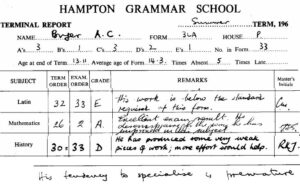
Extract from Hampton Grammar School report

The facts do indeed justify the conclusion!

Two from Hampton Grammar School stand out. It’s an institution I carry less than fond memories of and yet I remember many individual teachers with affection.

Maths was my strong subject as this report extract shows (I’m not sure why this term’s class ranking was so low). Unfortunately I didn’t apply myself to most other subjects.

For O-level maths our teacher was the elderly (to us schoolboys) Frank Steffens. He was an old boy of the school having been Head Boy c.1924-5. He went off to university, then returned to HGS to spend the rest of his working life as a maths teacher. His apparent sternness disguised a kindly nature. He wanted every boy in his class to succeed and we did. I’m not sure whether today’s teachers would be allowed to make the weakest pupils of the week sit in the front row on the following week, but it was a tactic that worked!

I was in the ‘Latin A’ [express] stream which meant that we took our O-levels after four years instead of five; for maths we took the ordinary exam in January followed by Additional Maths in June. There were 32 of us in the class (not streamed for maths); 28 of us got a grade A in the O-level, 4 got B’s and 4 C’s (when pass grades were A-E), an extraordinary achievement. Later, in the sixth form Mr Steffens took us for a general studies class. Us boys were amazed that someone so ancient (he would have been in his early 60s!) could understand and explain to us the science behind Dolby stereo!

We started our A-level studies under Stan Barton, who was also Deputy Head. With an interregnum between heads, he was often called away and so would set work for us to get on with in his absence. Not too much work was being done when Alan Waltham, head of maths, happened to walk by the classroom and hearing our chatter decided to investigate. He decided that it would be best if our group could sit in his classroom and get on with our work while he taught his main class, breaking off occasionally to check on our progress. Finding that four of us were well ahead of the others he offered to coach us to sit pure and applied maths as two subjects rather than sit the combined paper, an offer which we accepted. And so this left him teaching three different groups at the same time! And we all passed!

Then to Reading University: No specific maths classes but in my last year those of us in the Building Surveying stream had a weekly structural engineering class. It was the high spot of my week, not so for most of my fellow students. Our lecturer, Mike Hewitt, owned a calculator which could calculate sines and cosines! We were in awe of this device which had cost him a couple of months salary. We did our calculations with slide rules! He understood that some were not mathematically inclined: “In the exam there will be seven questions and you have to do five. 4½ will be mathematical questions and 2½ essay questions [i.e. one half-and-half]. That’s so those of you who can’t add up 2+2 can at least pass on the essay questions and the clever buggers among you [looking at me] can’t get 100%”. He’d be pleased, I hope, to see what this ‘clever bugger’ has been doing for most of his working life.

Memories of Junior School – The Teachers

Archdeacon Cambridge’s Junior School’s building, next to Holy Trinity Church, was twenty years older than the infant school, its foundation stone having been laid in 1841. I will share more memories of the building in a future post. Sadly, a quick Google search failed to produce a picture. Nearly sixty years on, my memories are vague, but perhaps some comments will flesh them out.

Compared with many modern schools, Archdeacon [as it tended to be known] was a small school, six teachers, head and school secretary – much like ‘King Street Junior‘, a BBC radio comedy. In my final year we had 42 in the class, so I would guess that there were about 200-240 pupils.

On entry, presumably following reports from infant school, pupils were put into one of two streams. Those judged (at age seven!) to have less academic potential were put in Mrs Stringer’s class for their first two years. Nearly sixty years on I remember her as a kindly soul. For their second two years her pupils would be passed on to a Mr Laing, then probably not far from retirement, who to us seemed to be dour unfriendly man. From what we gathered (perhaps incorrectly) he didn’t do much teaching, it having been determined that his pupils would never amount to much. Rather he supervised them as they did craft and other activities. All a bit sad in retrospect.

Meanwhile, those of us who were judged to be of average or better ability went through four classes, The first (year 3 in today’s parlance) was taken by Miss Weir, a middle aged lady who was a very effective teacher. In addition to her regular teaching, she conducted country dancing lessons. Away from school, she was a church organist in Hampton.

The next year’s class teacher was a Miss Cooper who returned from one holiday as Mrs Palmer. I have no memories of her, as four of us who were judged to be academically ahead were jumped a year and so missed being in her class.

So my next teacher was Mrs Atkins. I think she retired not too long after I left. She had a somewhat undeserved reputation as a stern disciplinarian but was another excellent teacher. One key thing I remember about her was that she drove a car, a Mini. The four of us who had jumped a year found ourselves with a different set of classmates but we soon fitted in.

For the last year (my last two years) we moved up to Mrs Piggott’s class. She was another excellent teacher, probably in her 30s, and she had a degree in maths. My enthusiasm for this subject was noted and encouraged. It must have been quite challenging to be teaching a class of 42, but a good number of us made it on to grammar school.

By today’s standards, the support team was modest. Mrs Hare, a quietly efficient no-nonsense lady was the school secretary, her duties including acting as school nurse, attending to sick pupils and the results of the inevitable falls. Mr Broughton, the school caretaker, was responsible for cleaning and, in the winter, maintaining fires and delivering buckets of coal to each class.

And last but not least was our head, Mr Brown. He’d been headmaster since 1948. Underneath a rather bluff exterior, he was a kindly soul who really did care for the well-being of the school and its pupils. He like Mrs Atkins, drove to the school, but in contrast to her state-of-the-art Mini, he drove a blue sit-up-and-beg Ford Popular. Despite the antiquated buildings he ran a good and happy school. Sadly he died suddenly on 29th April 1965, not too long after I’d left.

Biographical details of Frederick Finlay Brown, headmaster, corrected 2 March 2025

Arrested for spying again!

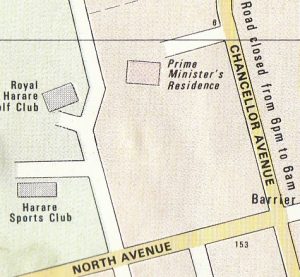
Extract from Harare tourist map

Extract from Harare tourist map

Harare, November 1997, a city laid out as a grid with many fine buildings and beautiful parks and gardens. On consulting my tourist map, publisher The Surveyor-General of Zimbabwe, I decided to go and see the Prime Minister’s residence, just as in past times tourists to London would go to see 10 Downing Street.

I wasn’t the first British tourist to do this. Alexander Chancellor records “In 1982, when I was in Zimbabwe, I took a stroll down Chancellor Avenue in Harare. I made a point of visiting this particular street because Chancellor Avenue was called that after my grandfather, Sir John Chancellor, the first British governor of Southern Rhodesia (as Zimbabwe was once called). I was surprised that it still bore his name, because it was already two years since independence and the new government had been busy eliminating the last vestiges of colonial rule.^

So one bright morning I took the short walk from the Bronte Hotel to Chancellor Avenue and peered through the gates – from memory the residence was well screened so not much to see. In next no time a couple of young men (cadet soldiers?) came over and arrested me. Fortunately I hadn’t taken my camera – this was still the era of colour slides so pics were carefully rationed. I wasn’t carrying any ID either, which was less helpful. Progressively I was passed up the ranks to soldiers with more and more stripes, one of whom then drove me back to my hotel to confirm my ID.

At the hotel my passport details were noted. I was told that I was free to leave the hotel during the day but must be back by 6.00p.m. in case they needed to take things further. By now I was a bit worried: could I please phone the British Consulate, I asked. No, need I was told.

So after a pleasant day I returned to the hotel. Shortly after six the phone in my room rang. “Reception here, there’s two gentlemen who want to talk to you.” Now I knew I was in trouble! I walked across the garden in some trepidation. Two well dressed men greeted me. “We’re from the Prime Minister’s office. We’ve been told what happened to you this morning and have come to apologise. We hope it won’t spoil your visit.” In reply I thanked them, also pointing out that the residence was shown on a government-produced tourist map that was on sale in the city. “Not any more!”, came the reply!

And, yes, I did enjoy my stay. I was fortunate to be visiting just before Zimbabwe really spiralled downhill.

I’d always wanted to go on a Boeing 707 …

I didn’t make my first independent overseas trip until I was 32, though since then I’ve made up for it by flying more than a million miles. For years it was a matter of regret that I’d left it too late to be a passenger on the icon of the jet age, the Boeing 707. And then ….

In November 1997 I made a short trip to Bulawayo, Zimbabwe. The flight from London to Harare used a 767, and I was expecting a 737 for the short hop from Harare to Bulawayo. But no, to my surprise and delight this flight would be on a Boeing 707.

Air Zimbabwe’s Boeing 707

Even better, in contrast to the usual African prohibition of taking photos at airports, the security officer was more than happy for me to take pictures of the plane (this is a scan of a slide, and so not the best quality).

The question I didn’t ask myself was “Why is Air Zimbabwe using a four-engine transcontinental jet for a flight with a duration of about 40 minutes?” – I was too excited at my wish coming true.

I found out later (assuming my informant was correct). The plane had failed its airworthiness checks so Air Zim couldn’t take it out the country! Apparently a couple of weeks later the pilots refused to fly it. But at the time it seemed fine to me, one air trips I will always remember.

Random memories of living in Mexico City

Not many people know that I spent two years living in Mexico City, 1957-59. I was three when I went and five when I returned so my memories of this period are very vague. Looking back I now wish I’d pumped my parents for information but it’s now too late. Here’s a summary of the little that that I do know and remember:

  • We went to Mexico because my dad was posted to the British Embassy as Labour Attache, one of six diplomats working under Sir Andrew Noble, Ambassador.
  • We went as a family (dad, mum, my younger sister and me) on the Cunard RMS Media, sailing from Liverpool to New York, then getting the train from NYC to Mexico. The Media (not that I remember it) was an interesting ship, the first built for Cunard after WWII. She entered service in 1947 and was a combination 250-passenger/cargo ship.
  • My dad was not a total stranger to diplomatic life as he’d worked in the British Embassy in Venezula in the late 1940s (he and my mum met through a penpal club – the immediate postwar version of internet dating!), but for my mum, coming from a working class background, it was an enormous challenge, but one she rose to. Not only was she expected to accompany my dad to diplomatic functions, but was expected to host them too.
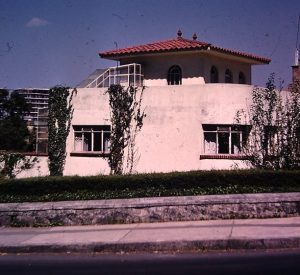
  • Our home in Mexico City

    Our home in Mexico City

    We lived in two embassy-provided houses. I don’t remember the first, but would instantly recognise the second if taken there – looking from the road, at the right hand size there was a steeply dropping drive down to a double garage. To the left of this was the house, entered from the street by walking across a ‘bridge’ – the principal entertaining rooms were at first floor level. At the bottom of the garden, over the fence, was some sort of stream or small river.

  • We also had an embassy car (a Ford Zephyr Mk.1) and driver, Augustus. It was in Mexico that  my mum learned to drive.
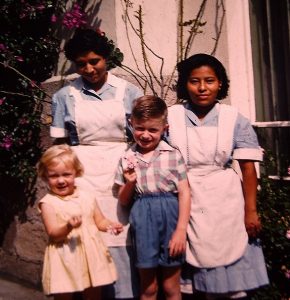
  • My sister and me with our maids

    My sister and me with our maids

    We were assigned two Mexican maids, Dolores and Mercedes. Apparently I quickly became a fluent Spanish speaker but lost this just as quickly on returning to UK.

  • I went to an English-speaking nursery school run by one Mrs Bone. I remember nothing of it unfortunately.
  • Our best friends were the Wade family: David Wade was a Shell executive so presumably met my dad via the embassy. We and their two (at the time) children were good friends and maintained contact for years after we returned to Twickenham and Sidcup respectively.
  • Dad was awarded an MBE in the 1957 birthday honours list. He was presented with it when Princess Marina, Duchess of Kent visited Mexico in 1959.
  • We returned to UK in 1959. To get my dad back to work in London asap, they put him on a plane (then the more expensive option), leaving my mum to cope with two small children on the long train journey back to NYC, then the transatlantic crossing on the Queen Mary – not half as enjoyable as it might have been for her with two small children to look after and no spouse to share the load.

Postcript

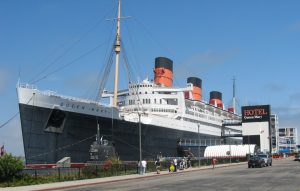
  • Queen Mary at Long Beach 2010

    Queen Mary at Long Beach 2010

    In July 2010 after visiting Dallas for a software conference I took a stopover in LA so I could finally achieve one of my great ambitions, revisiting the Queen Mary. I booked a three night stay and in special requests put ‘returning passenger’. When I checked in, I was given a room upgrade! See Two Queens and me

  • Life as a British Labour Attache in Mexico in the 1950s

In hospital – some random thoughts

The theme of my 60th birthday speech a few years back was ‘Life’s not fair’. I noted that I had enjoyed far more of life’s good things than most people, including good health and the extraordinary ‘achievement’ of having reached 60 without a single night in hospital (before you ask, I wasn’t born in one). But I’ve made up for this since, starting with a stay in the public Royal Melbourne Hospital in 2014.

Last month I spent two weeks in hospital, a week in Melbourne Private Hospital, then a week in rehab at Epworth Camberwell. How did this compare to my limited experience (as a visitor only) of English hospitals?

Firstly the UK and Australia have different attitudes to private health insurance. In UK private health insurance is generally offered as a perk by employers; few individuals buy it. Around 10% of the population are covered according to the Telegraph web site. Premiums are subject to 12% insurance premium tax and if your employer pays the premium, this is taxable as a fringe benefit .

Here in Australia it’s the opposite – roughly half the population have private health insurance^ even though they’re covered by our NHS-like Medicare. The private system is seen as taking load off the public system so if you don’t have private health insurance you may have to pay additional income tax (Medicare Levy Surcharge 1-1.5%). In addition the government pays part (33% in my case) of your premium as a rebate. Interestingly insurance companies are not allowed to cherry pick – e.g. All 63 year olds taking out the same policy with a particular insurer must be charged the same premium regardless of their medical history.

Bed space at Epworth Camberwell

Bed space at Epworth Camberwell

So staying in a private hospital is nothing exceptional in Australia. My rooms in each hospital, twin occupancy, weren’t that special, though TV and wifi were free. I could not fault the treatment I received. Without exception, the staff were excellent. As in UK hospitals, a good few of them were from overseas, working on contract.

But, unlike UK hospitals which in my limited experience are overheated during the winter, my rooms were cold and I had to ask for an extra blanket!

Melbourne Private Hospital chicken salad

Melbourne Private Hospital chicken salad

The food was good too (not a comment often heard from UK hospital patients), excellent at MPH, though surprisingly I struggled to find low-fat options on the menu. Useful hint for anyone under orders to lie flat on their back (for 48 hours in my case): pick toast for breakfast and sandwiches for lunch and dinner – you can eat them lying down without help!

But of course the best thing that happens in hospital is being told that you’re now ready to be discharged. In my case this was on my birthday, a great birthday present!