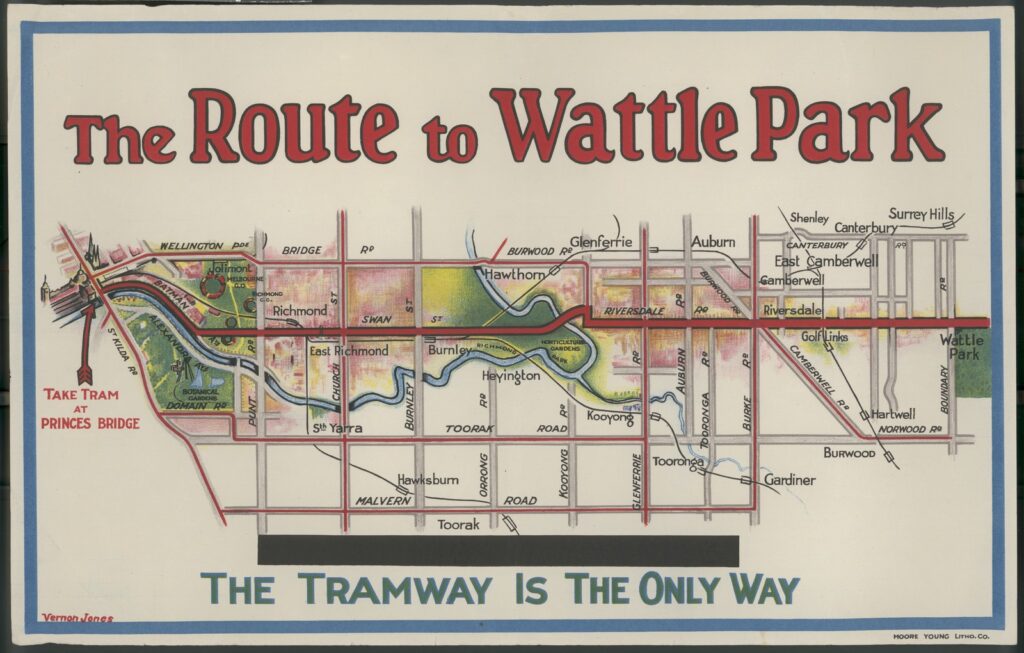
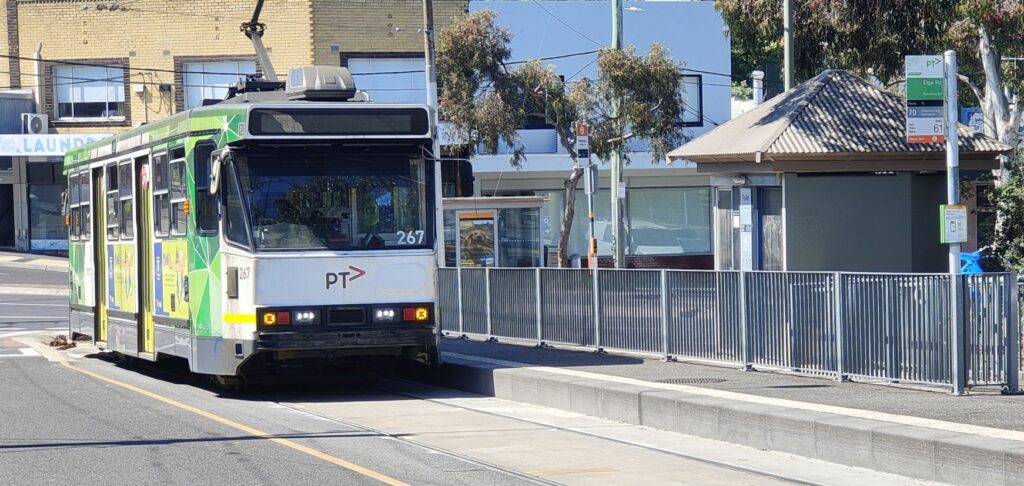
From my home here in Docklands, immediately west of Melbourne’s CBD, six tram routes run through the CBD out to the suburbs. This post looks at route 70 to Wattle Park, 16km (10mi) east of the CBD, in particular the 1920s line extension to the park.
Route 70’s roots lie in the Hawthorn Tramways Trust (HTT) line from Melbourne CBD via to Burwood via Hawthorn, opened in 1916. This was the first electric tram route serving the CBD; all other trams were then cable-powered. From 1924 Melbourne’s cable trams were progressively replaced by electric trams or buses, the last cable trams being withdrawn in 1940.
To generate more traffic for the line, the HTT purchased a 55-hectare (137-acre) site for use as a public park. The park opened to the public from in December 1916, then being opened on 31 March 1917 by the Governor, Sir Arthur Stanley, who planted a Golden Wattle and gave the park its name.
These few excerpts from contemporary newspapers record key events. They’re taken from Trove and heavily edited for length. Click on the ^ next to the citation to read the whole story:
Melbourne Argus, Friday 26 May 1916 ^
SUBURBAN TRAMS: FIRST CAR REACHES BURWOOD
The first electric car to travel the full route of the new tramway from Prince’s Bridge ran into Burwood yesterday afternoon. Residents, who saw the dream of years at last realised, gave the tram and its passengers a cheer. … The fourth section to Bowen street, Camberwell, which makes the end of the double track, will come into operation next Wednesday… . It has practically been decided to open the full route to Burwood for traffic on June 10. By that date the Hawthorn Tramway Trust hopes to have its full fleet of 20 cars on the track.
Camberwell and Hawthorn Advertiser, Saturday 14 April 1917 ^
OPENING OF WATTLE PARK
A short time ago the Hawthorn tramways trust acquired, at a cost of £9000, 137 acres of land near the present terminus of the Riversdale Road electric tramway. When the proposal to secure this area as a park was first mooted, considerable opposition was levelled at the idea by the Melbourne city council … and as its consent was necessary before the purchase could be effected, for a time the proposition appeared as if it would fizzle out. However, representations were made to the Nunawading shire council … as a result that council consented to contribute its share of the purchase money, which rendered the establishment of the park possible, as the city council then withdrew its objection and the land was jointly acquired… .
The reserve is in Nunawading territory, just outside the area of city of Camberwell and from the Boundary road corner and other points of vantage in the acquired area is revealed a glorious panorama of hill and dale, comfortable homesteads, smiling fields of cultivation, with the Dandenong ranges in the background. A fine view of the bay is also attainable. A good deal of native timber has been preserved, and with additional planting and other improvements, the reserve is to be further beautified. Some of the open spaces are to be utilised for cricket, football and other sports. … The official opening was performed on … March 31, by the state governor (Sir Arthur Stanley).
After planting the first tree, Sir Arthur said … named the place ‘Wattle Park.” He extended congratulations to the chairman of the tramways trust (Mr. Dureau) on the civic spirit displayed in creating the park. No doubt he had in the back of his mind the idea that the park itself might create traffic for the trams, thereby mixing the altruistic spirit with the commercial. … The present park was in a great and growing district and would prove to be one of its lungs. …
Afternoon tea was partaken of by the visitors in a spacious marquee, and after the singing of the National Anthem, the governor’s health was proposed by Mr. Dureau … Sir Arthur Stanley, in responding, said … The tramways were being very successfully and most economically handled by the municipalities, but he could not say the same of tramway management on the part of the government. … An extension of Riversdale road tramway was needed to take visitors to a central position in the park, and he hoped there would be no delay in obtaining the necessary authority for the extension.
The minister for public works (Mr. Adamson) … was convinced of the necessity for extending the tramway half a mile or so to convey people to the park, and having been assured the requisite material was available, would endeavor to secure for the trust permission to undertake the extension. …
Most probably because of financial constraints, the extension was a long time coming.
Box Hill Reporter, Friday 5 August 1921 ^
WATTLE PARK TRAMWAY EXTENSION
At a public meeting in August 1921 it was resolved “that the Metropolitan Tramway Board be urged to proceed at once with the extension of the Wattle Park electric tramway to the eastern end of the park in accordance with the provisions of the Tramway Act. … Mr. Earle (South Riding Progress Association) moved the adoption of the resolution, and said how tired they all were with the continual evasions and delays of the Tramway Board, The equipment was admittedly purchased long since for the short extension being asked for; the order-in-council had been obtained, there was no veto by the Railway Commissioners to combat, and during the last few days a waiting-room had actually been placed at the corner of Riversdale and Elgar roads. …
Finally on June 30th 1928 the tram extension was opened.
Box Hill Reporter, Friday 6 July 1928 ^
WATTLE PARK TRAMWAY EXTENSION
Official opening
A large and interested crowd of spectators witnessed the opening of the new Wattle Park tramway extension from Boundary Road along Riversdale Road to Elgar Road on Saturday afternoon last. The Mayor of Box Hill (Cr J.G.Murphy), at the request of the Chairman of the Tramways Board (Mr A.Cameron), officially declared the line open. A white satin ribbon stretching across the road in front of the first tramcar was cut by the Mayoress, Mrs J.G. Murphy, after which two trams, having as passengers the official guests, left on their first journey to the new terminus at Elgar Road, amid loud and enthusiastic cheering from both passengers and onlookers. The cars then returned to the centre entrance to Wattle Park, where the guests alighted, making their way to the Chalet, where afternoon tea was dispensed …
Cr. Proudfoot … expressed deep appreciation of the fine public service rendered by the Board in Melbourne and the metropolitan area. … The new extension just opened would, he hoped, have good results, and add to the increasing popularity of Wattle Park. … In all extension work the Board had endeavored to carry out activities where there was a great wealth of demand, these, of course, only being able to be built as revenue would afford. …
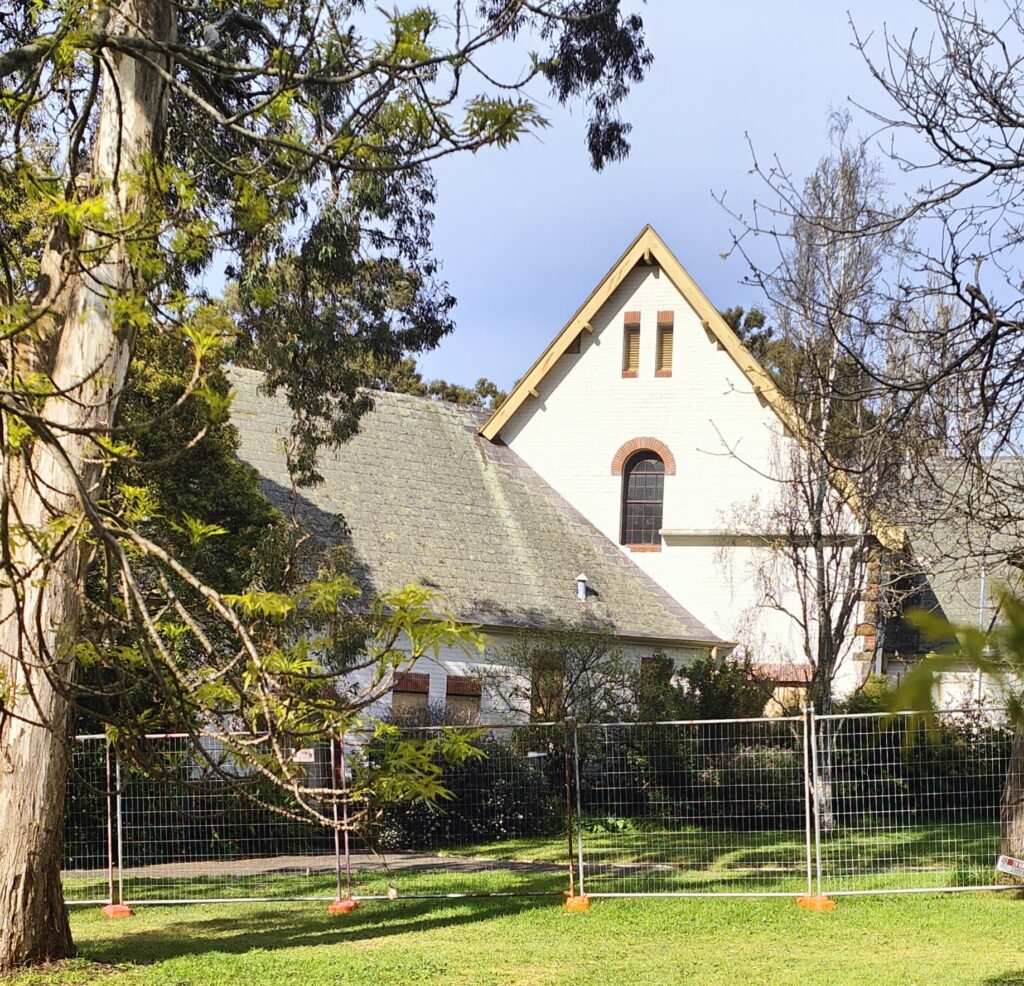
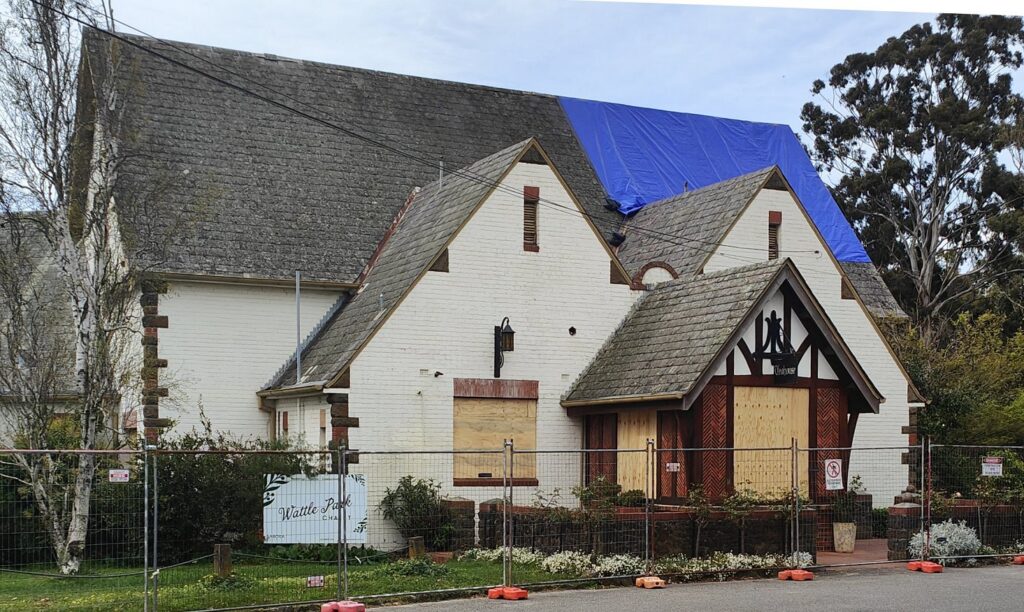
The Chalet, which is situated on the highest part of Wattle Park (about 450 feet above sea level), introduces rather a new note in Australian architecture, being built and designed to resemble an old English inn. It has a large central hall and two wings, one of which is to be used as caretaker’s quarters and the other for service and shop. Five to six hundred people can be accommodated in hall, balcony and loges, while probably 1000 people could be catered for on lawns, terraces, etc., in the summer months.
The park itself is an area of 137 acres, upon which approximately 7000 trees have been planted by the Board. It is a picturesque and delightful spot, where every facility for sport is provided, and children are catered for in a manner which makes Wattle Park the popular rendezvous for all young people’s picnics.
The park today
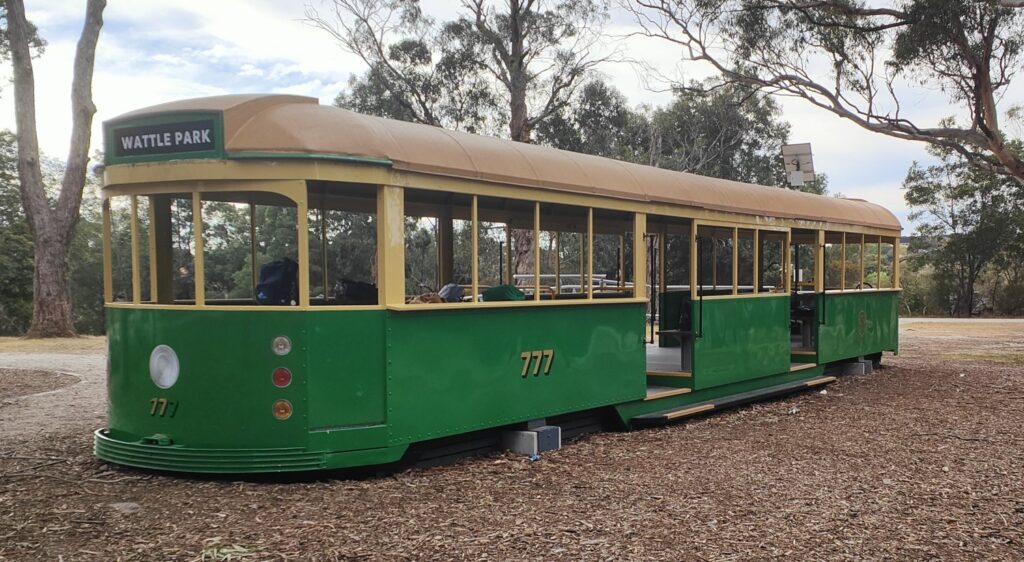
Facilities include a playground, barbecues, tables and seats, public toilets, a war memorial clocktower, stables, a lily pond, sculptures and Indigenous interpretive elements, a large sports oval, a nine-hole public golf course and tennis courts with cafe, two heritage ‘W’ class Melbourne trams offer shelter, walking tracks through the bush and a perimeter track, and the Wattle Park Chalet – a wedding and function centre. Dogs are permitted in the park on a lead.
The current ‘trams’ use W-class tram bodies – they’ve been rebuilt with steel replacing timber after numerous predecessors were destroyed by arson.
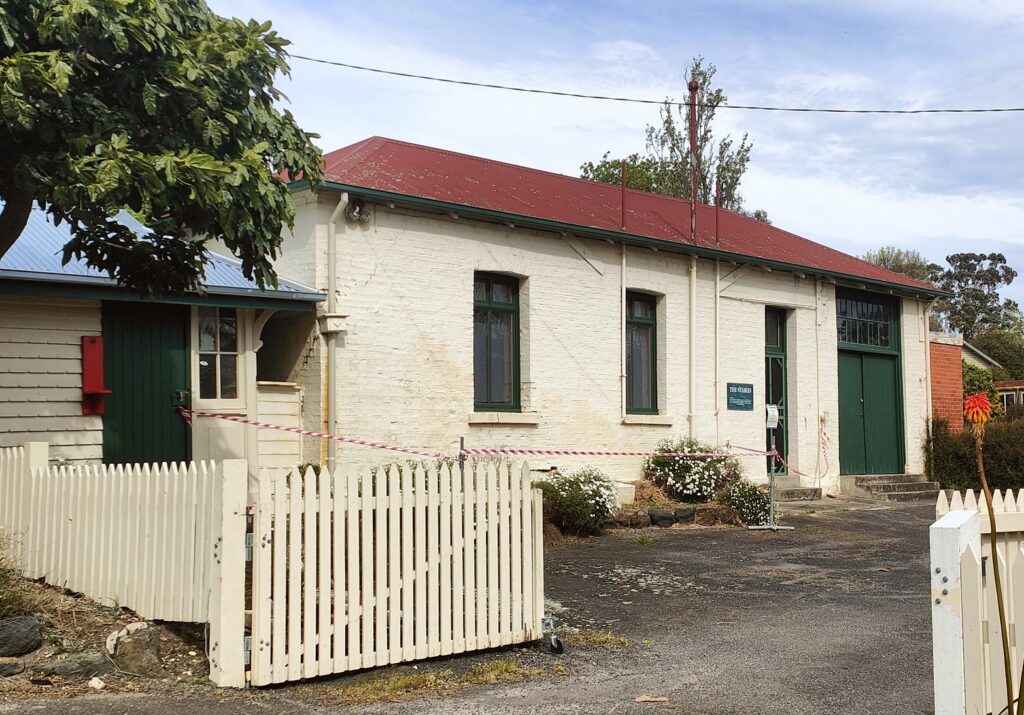
The Chalet was built in 1928 as a tea-house as well as a scenic wedding and function venue. It was designed by Alan Monsbourgh, the Melbourne & Metropolitan Tramways Board’s architect 1926-38, and built largely from reclaimed materials – bricks and slate paving from redundant cable tram engine houses, roof slates from the Yarra Bend Asylum and stonework from derelict drystone walls. Tragically on September 12th 2026 the chalet was extensively damaged by fire and will be out of use for a considerable period.
The “Lone Pine” tree growing near the main carpark was grown from the seed of a cone collected from the lone pine tree in Gallipoli, Turkey. Today this tree is still one of two surviving trees from Victoria’s original 1933 Lone Pine plantings. In the 1950s a stone clock tower was constructed adjacent to the Lone Pine seedling, dedicated to a soldier who fell in World War I.
With increased car ownership from the 1960s the MMTB and then the Metropolitan Transit Authority, focused their attention elsewhere. Subsequently, local residents began to complain about the poor state of the park. In June 1989, ownership of Wattle Park was passed to the Public Transport Corporation, in 1991 to the Melbourne & Metropolitan Board of Works, then being vested in Parks Victoria in 1996. Since then a lot of time and money has gone into improving the park and securing its future.
Wattle Park conservation management plan
SLV 1930s map source